

World Cup Special • Save up to $1000 on selected vehicles

Guazi
GlobalEnglish


How to Import Chinese Cars to Georgia After the 2026 Vehicle-Age Rule
Article OverviewImport Chinese cars to Georgia guide covering eligibility, 2026 age rules, excise tax, customs fees, EV checks, and registration.
Data note: This guide uses Georgia import, tax, and registration references checked on 23 July 2026. Vehicle eligibility rules, excise rates, customs services, registration deadlines, and calculator outputs can change. Recheck the exact VIN, age, engine, steering position, fuel type, and Revenue Service calculation before payment.
Georgia is an interesting market for Chinese cars because the decision is not only about price. A Chinese EV, hybrid, or compact SUV may look attractive at the buying stage, but the real question is whether the exact vehicle can clear customs, fit Georgia's import rules, and make financial sense after excise, registration, service, and parts planning.
To import Chinese cars to Georgia, start with eligibility before you start with freight. That is especially important after Georgia announced a 2026 restriction on older M1 passenger vehicles, with an exception for electric vehicles. A cheap used car from China is not cheap if it cannot be registered or if the excise calculation destroys the budget.
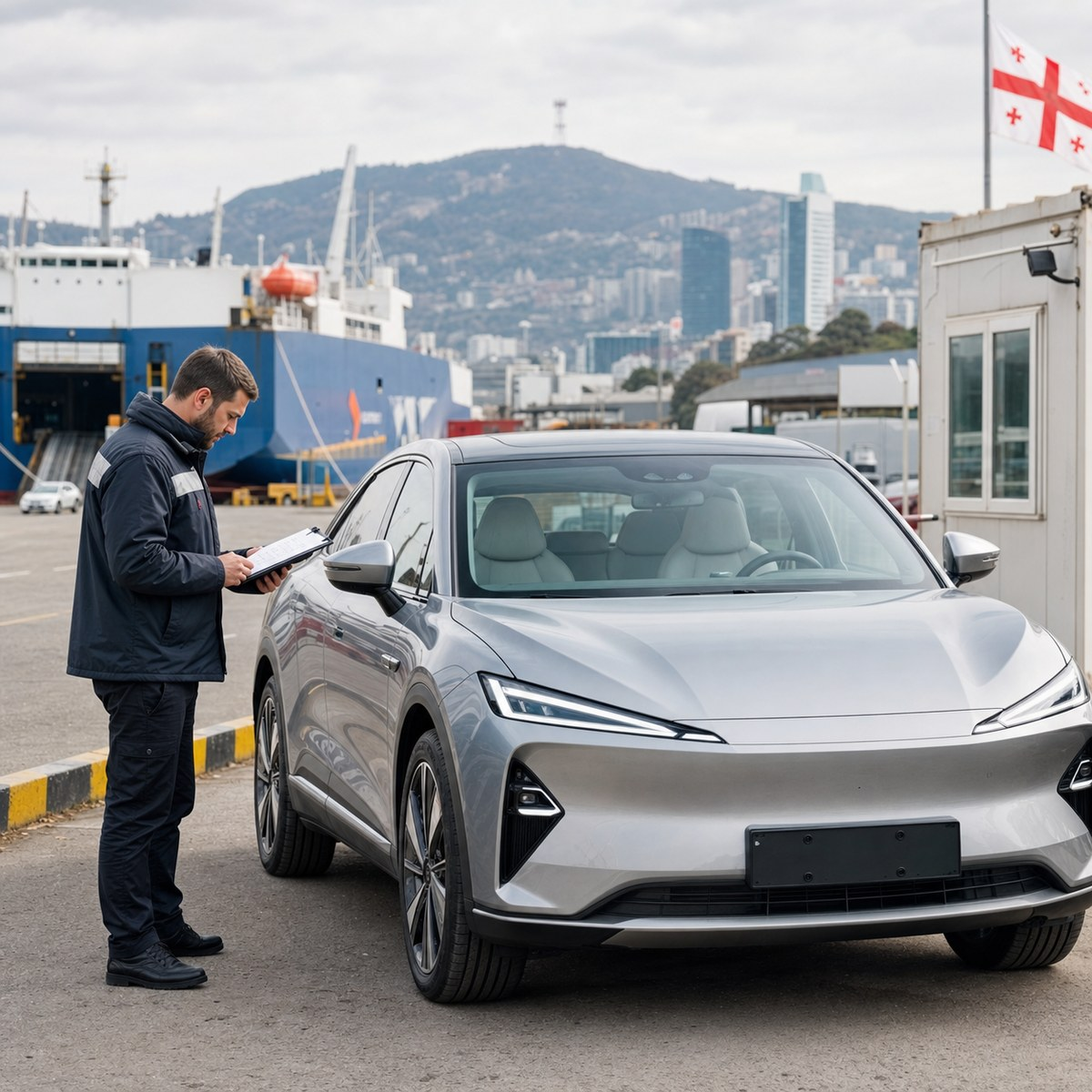
The short answer on importing Chinese cars to Georgia
- Check the car's category, age, VIN, steering position, fuel type, engine size, and EV status before deposit.
- Use Georgia Revenue Service's Auto/Moto Levy Calculator for the exact unit instead of guessing tax and fee totals.
- Watch the 2026 M1 vehicle-age rule. Georgia announced that from April 1, 2026, import, first registration, and temporary registration of M1 category vehicles older than six years are prohibited, with electric vehicles exempted.
- Prepare invoice, export documents, bill of lading, VIN evidence, inspection report, and registration/ownership documents before shipment.
- Plan for customs clearance, declaration, service fees, transit/registration steps, inspection, and first service.
- Treat right-hand-drive or steering-converted cars with caution because Georgia tax text can impose much higher excise on those cases.
The core rule is simple: do not ship the car until eligibility and tax exposure are clear.
How Guazi Used Cars helps you structure a Georgia import
Today, buyers in Georgia can import both Chinese domestic brands and global brands manufactured in China through the Guazi platform. Guazi also supports a structured export process, and in Georgia, AIG is recognized by Guazi as an official partner for importing high‑quality China‑to‑Georgia units. If you are importing a Chinese car to Georgia, you need more than a seller quote and shipping contact. You need a structured way to check the vehicle, the documents, the shipping method, the tax exposure, and the registration path before the car leaves China. This process helps you work through the decision in a reliable, step‑by‑step order.
As a buyer, you can use this structure to compare China‑source EVs, hybrids, SUVs, sedans, and China‑built global models against Georgia’s age rule, steering‑position requirements, excise logic, and registration timing. For dealerships, the same structure keeps the sourcing file consistent across multiple units instead of relying on scattered chats, screenshots, and rough freight quotes.
Use the process this way:
- First, confirm the vehicle: VIN, model year, mileage proof, inspection report, accident signs, battery or engine data, and ownership chain.
- Then check shipping readiness: whether the car is better suited to Ro‑Ro, container, or a routed alternative based on condition, value, and EV or hybrid handling.
- Next, build the cost file: China price, freight, insurance, excise, customs tax or import‑duty path, registration, inspection, and first‑service reserve.
- Finally, separate responsibilities: Guazi handles China‑side sourcing and documentation discipline, while your forwarder, customs broker, and Georgian registration handler manage live shipping, clearance, and local registration.
You should not treat Guazi only as a place to browse cars. For a Georgia import, the real value is that this structured process helps you ask the right questions before a cheap China quote becomes an expensive Georgian problem.
NEWS: Guazi Accelerates Global Expansion as Partnership With Georgia’s Auto Import Giant AIG Moves to a New Level
Georgia's 2026 age rule changes the import decision
Georgia's Ministry of Environmental Protection and Agriculture announced that from April 1, 2026, import, first registration, and temporary registration of M1 category vehicles older than six years are prohibited. The announcement says the restriction does not apply to electric vehicles.
That single point changes the structure of a China-to-Georgia import plan. A buyer who finds a seven-year-old petrol SUV at a tempting price should not treat it like a normal bargain. First, confirm category, age, and registration path. If the car is electric, the age restriction may not apply, but that does not remove battery, charging, software, customs, or registration checks.
For final payment, ask the seller or sourcing platform to show the model year, production date if available, VIN, registration history, and technical data. If the file is unclear, pause the deal.
The eligibility checklist before a China-to-Georgia deposit
Eligibility is the first budget line because a car that cannot be registered cleanly is not a bargain. Before sending a deposit, reduce the decision to a few hard checks and make the seller prove each one with documents, not screenshots alone.
| Check before deposit | What to confirm | Why it matters |
|---|---|---|
| Vehicle category | Whether the car is an M1 passenger vehicle or another category | The 2026 restriction is tied to M1 vehicles |
| Age and production evidence | Model year, production date if available, first registration evidence, and VIN | A non-EV older than six years may be blocked after April 1, 2026 |
| EV status | Whether the vehicle is fully electric, not just hybrid or mild hybrid | The announced age-rule exception applies to electric vehicles |
| Steering position | Left-hand drive, right-hand drive, or converted steering | Right-hand-drive or converted cars may face much higher excise |
| Engine or battery data | Engine displacement for petrol/hybrid, battery report for EV | Tax, risk, and service planning depend on this data |
| Registration path | Whether the customs and Service Agency files can be completed within the required timeline | Georgia registration guidance gives importers a 60-day planning pressure |
If one row is unclear, you should not treat the China price as real savings yet. The missing answer may become the most expensive part of the import.
Brand and model overview for Chinese-car imports to Georgia
The Georgia buyer should think in two groups. The first group is Chinese brands. The second group is global brands with China-built units. Both can make sense, but only when the exact VIN, build origin, specification, steering side, age, battery or engine data, and parts path are clear.
| Brand group | Brands or models to research | Georgia import caution |
|---|---|---|
| Chinese brands | Chery, Geely, Haval from Great Wall, BYD, JAC, Dongfeng, Wuling | Check age eligibility, EV status, steering, service support, parts access, and whether the model is already familiar to local workshops |
| Global brands manufactured in China | Tesla MIC Model 3 and Model Y, Volvo S90 and some XC60 China-built units, Ford Territory, Buick Envision, BMW Brilliance models, SAIC-VW and FAW-VW units | Do not assume the global badge removes import risk. Verify China-built specification, software, warranty transfer, parts support, and tax category |
| Popular Georgia options | BYD Song Plus, Chery Tiggo 7 and Tiggo 8, Geely Coolray and Atlas, Haval Jolion and H6, Ford Territory, Tesla Model 3 and Model Y, Volvo S90, JAC JS4 and JS6 | Treat this as a shortlist, not a recommendation. The best choice is the unit that survives the eligibility, tax, shipping, and service checks |
Chinese EVs deserve special attention because the announced 2026 age-rule exception for electric vehicles can make them more attractive than older petrol imports. Still, an EV with unclear battery health, China-only software, weak charging support, or no local diagnostic path can become difficult after arrival. The model name opens the conversation; the evidence file decides whether the car is worth importing.
The document file you need before the car leaves China
The document package should be ready before shipping, not rebuilt after the car arrives. Missing documents slow clearance and weaken your position.
| Document or proof | Why it matters |
|---|---|
| Commercial invoice | Supports purchase value and customs declaration |
| Bill of lading | Links the vehicle to the shipment |
| Export documents from China | Shows the vehicle can legally leave China |
| VIN and model data | Confirms identity, year, category, and specification |
| Previous registration or deregistration evidence if used | Helps prove vehicle history |
| Inspection report | Shows body, mileage, battery or engine, and accident condition |
| Battery report for EVs | Critical for Chinese EV imports |
| Ownership chain | Reduces fraud and document mismatch risk |
| Translation where needed | Keeps customs and registration review cleaner |
If the seller cannot produce a clean file, you should not rely on WhatsApp photos or a low price. Document weakness becomes customs risk.
Choose a shipping method before you calculate the Georgia landed cost
Before you calculate the Georgia-ready price, choose the shipping method for the exact car. A running petrol SUV, a China-built EV, and a dealer batch do not need the same logistics plan. Ask your forwarder for a live quote by VIN, route, week, port, and method, then add that quote to your customs, registration, and first-service worksheet.
Use this quick comparison before you approve the shipment:
| Method | Use it when | Planning range to verify |
|---|---|---|
| Ro-Ro | You have a running standard petrol car and a suitable China-to-Georgia service is available | Confirm departure port, arrival port, vehicle acceptance rules, insurance, and whether the car can drive on and off the vessel |
| Container shipping | You are importing an EV, hybrid, high-value unit, non-running car, or vehicle that needs enclosed protection | For sea freight to Poti or Batumi, use about 25 to 45 days as a broad planning window; some route listings quote about 26 to 35 days |
| Rail / Middle Corridor | You need a faster route and the budget can carry a premium | Often planned around 12 to 20 days before local handling variables, but route bottlenecks and cost still need live confirmation |
For cost planning, do not use one fixed shipping number. Recent market references vary widely: some China-to-Georgia vehicle-shipping listings sit around the high-\$3,000s to Poti or Batumi, broader sea-container references can move from about \$2,000 to \$8,000 depending on lane and box size, and rail references often discuss about \$5,000 to \$7,000 per 40ft container. As a buyer or dealer, your safest move is to collect two or three live quotes, compare what each quote includes, and keep the written quote with the vehicle file.
Use the Georgia Revenue Service calculator before you agree on price
Georgia Revenue Service provides an Auto/Moto Levy Calculator for vehicle customs clearance. This is the safest practical tool for buyers because the real cost depends on vehicle details.
The calculator exposes cost lines such as excise duty, customs tax, vehicle clearance service fee, customs declaration fee, expert examination act, internal transit number, registration certificate, vehicle registration number, and inspection act. Those are exactly the lines that a buyer needs to compare against the China purchase price.
Use the calculator before deposit, then run it again before final shipment if any vehicle detail changes. Do not use a broker's rough number as the only budget.
HS code and tax treatment should be checked before shipment
The Auto/Moto Levy Calculator is the most buyer-friendly starting point, but it should not be the only tax check. Georgia Revenue Service also provides a commodity-code path that can search VAT, excise, and import duty rates under the Tax Code of Georgia. For vehicle imports, that matters because the wrong category assumption can make a clean-looking quote unreliable.
| Tax question | Safer verification path |
|---|---|
| What commodity treatment applies to the exact vehicle? | Check the Revenue Service commodity-code or HS-code lookup for the relevant vehicle category |
| What excise logic applies? | Confirm engine displacement, age, hybrid status, steering position, and current legal text |
| Are VAT or import duty lines relevant? | Use the Revenue Service lookup/calculator path instead of assuming from another importer's case |
| Does the broker's estimate match official inputs? | Compare the broker quote with calculator lines and saved screenshots or PDF output |
This is not about turning you into a customs lawyer. It is about preventing a deposit decision based on the wrong tax category.
How excise logic can change the whole deal
Georgia's Tax Code includes passenger-car excise rules under commodity item 8703. The official legal text should be rechecked at final drafting and before purchase, but the current planning logic is clear enough for buyer discipline.
For passenger cars 0 through 6 years old, the excise rate is listed as GEL 1.5 per cubic centimetre of engine displacement unless otherwise established. For cars more than 6 years old, the listed rate is GEL 4.5 per cubic centimetre. Left-hand-drive hybrids 0 through 6 years old receive a 60% reduction. Right-hand-drive or steering-converted cars can be charged three times the relevant rate.
That means engine size, age, hybrid status, and steering configuration are not small details. They are budget drivers.
| Vehicle factor | Why it changes the tax conversation |
|---|---|
| Engine displacement | Excise can be tied to cubic centimetres |
| Age | Older non-EV passenger cars may face both tax and eligibility pressure |
| Hybrid status | Some left-hand-drive hybrids may benefit from a reduction |
| Right-hand drive or converted steering | Can carry a much higher excise multiplier |
| EV status | May avoid the 2026 age restriction, but still needs full cost checks |
The China price is not the Georgia-ready price
Many import mistakes start with comparing the wrong numbers. A China seller price or FOB quote is not the cost to drive the car legally in Georgia.
| Cost line | How to verify it |
|---|---|
| China purchase / FOB | Exact car, VIN, specification, and included export documents |
| Freight and insurance | Route, port, shipping method, timing, and coverage |
| Excise duty | Use engine, age, hybrid, steering, and legal status in the Revenue Service path |
| Customs tax or import duty | Verify through Revenue Service calculator and HS code lookup |
| Clearance and declaration fees | Include service and declaration lines from the calculator |
| Transit and registration | Include internal transit number, certificate, plates, and registration steps |
| Inspection and first service | Battery or engine check, tyres, fluids, diagnostics, software, and accessories |
If two cars have the same purchase price, the one with cleaner tax and registration logic may be the cheaper car.
What to check before importing a Chinese EV to Georgia
Chinese EVs can make more sense in Georgia than some older petrol imports because the 2026 M1 age restriction announcement says the restriction does not apply to electric vehicles. That does not mean every EV is a good buy.
Ask for battery health, fast-charging history if available, connector type, software language, warranty status, service access, spare key, charging cable, and diagnostic scan. Also check whether the car's navigation, connected services, and app features work outside China. Some China-market EV features may be limited after export.
EV buyers should also price the first ownership kit: proper charging cable, adapter if needed, tyre condition, brake service, coolant or battery-system inspection, and local diagnostic support.
The 60-day registration pressure
Georgia Service Agency guidance says a mechanical vehicle brought into Georgia for registration from abroad must be registered within 60 days. Treat that as a planning deadline, not a casual reminder.
You should know who is responsible for customs declaration, internal transit, inspection, registration certificate, plates, and any missing document fixes. If the car arrives with a weak file, the clock becomes uncomfortable quickly.
For dealers, the 60-day window also affects cash flow. A car stuck in document correction is not inventory. It is money waiting for paperwork.
| Arrival step | Who should own it before shipment | What proof you should keep |
|---|---|---|
| Customs declaration | Clearing agent, buyer, or importer of record | Declaration record, invoice, bill of lading, and vehicle identity data |
| Levy and fee calculation | Buyer and clearing agent together | Revenue Service calculator output and HS/tax lookup notes |
| Internal transit and inspection | Clearing/registration handler | Transit number, expert examination or inspection act where applicable |
| Registration certificate and plates | Buyer, dealer, or registration handler | Service Agency submission record, registration certificate, and plate documents |
| Missing document fixes | Named person before the car ships | Written responsibility for translations, corrected invoices, VIN evidence, or ownership proof |
How Guazi sourcing discipline helps import buyers
When importing from China, you often make a large decision before physically touching the car. Evidence has to replace hope. All cars listed on the Guazi platform undergo over 200 professional inspections, and that inspection mindset is useful even before the Georgian customs file starts.
A strong sourcing file should include VIN, mileage evidence, accident checks, body photos, diagnostic scan, battery or engine proof, tyre age, interior condition, key count, export-readiness documents, and a clear quote. If the file does not show enough, you should negotiate risk into the price or choose another unit.
A step-by-step China to Georgia import workflow
Start by choosing a vehicle that fits Georgia's eligibility and tax logic. Then confirm documents before deposit. Run the Revenue Service calculator using the exact unit details. Confirm freight, insurance, and arrival path. Prepare customs declaration documents, then handle clearance, transit, inspection, registration, and first service after arrival.
The best import plan is not the fastest-looking plan. It is the plan where the car's age, steering, engine or battery, documents, tax exposure, and registration timeline are known before you pay.
Key Takeaways
- Import Chinese cars to Georgia only after checking age, M1 category, EV status, steering, engine size, and document file.
- Georgia announced an April 1, 2026 restriction on M1 vehicles older than six years, with an exception for electric vehicles.
- Use the Georgia Revenue Service Auto/Moto Levy Calculator for the exact unit instead of guessing.
- Excise exposure can change sharply with engine size, vehicle age, hybrid status, and steering configuration.
- A low China price is not enough. Build a Georgia-ready cost worksheet before deposit.
Get help comparing inspected cars
If you are comparing Chinese cars for Georgia, start with budget, fuel type, EV or petrol preference, model year, steering position, and expected registration timeline. The Guazi team can help compare documented used-car options and avoid weak-history units before shipment. Contact the sourcing team or review current used-car inventory.







About Us
Follow US


Copyright © 2015~2026 https://ylqc.guazi.com/, Yilanqunche Automobile Services (Shanghai) Co.,Ltd. All rights reserved.