


Guazi
GlobalEnglish


Makes
Buy It NowAuctionsUp to 160 psPort StockAll VehiclesPopular Makes


Shop By Type


Popular Models


Shop By Budget

How Georgia Became the Used Car Hub of Eurasia
Article OverviewWhy Georgia re-exports billions in used cars a year, how the Rustavi market works, where cars flow to Central Asia, and how Chinese cars and EVs ride the same corridor.
A country of fewer than four million people, wedged between the Black Sea and the Caucasus mountains, now sends billions of dollars of used cars out its borders every year. That is the strange, true shape of used car re-export in Georgia, a trade that has grown so fast it has reordered how vehicles move across half a continent. Cars arrive from the United States, Europe, the Gulf and, increasingly, China; they pass through Georgian ports and the great open-air market at Rustavi; and they leave again, mostly headed east toward the buyers of Central Asia. Georgia is not really the destination. It is the pivot.
This guide explains how that pivot works and what it means in 2026. We will look at why geography and light-touch trade turned a small country into Eurasia's car bazaar, walk the Rustavi market that is its beating heart, follow the cars to where they actually go, and trace the newest current in the flow, the fast-rising movement of Chinese cars and electric vehicles toward Central Asian demand. Guazi appears here as the China-side sourcing lens on that last leg. One honest note before we start: this piece is about legitimate Central Asian trade, and the Russia question that hangs over Georgian re-export gets handled squarely, not dodged, in its own section below.
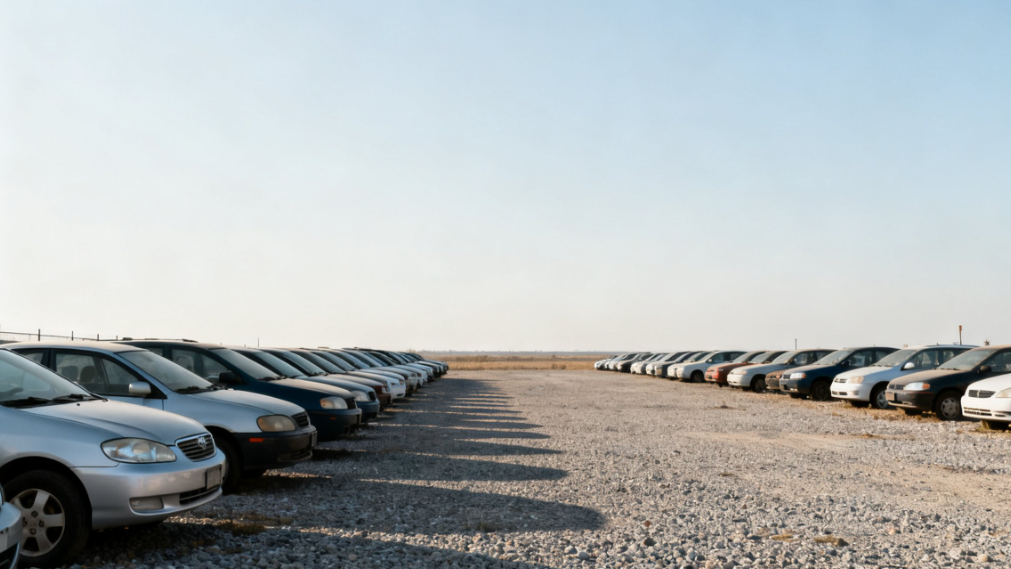
Why a small country became Eurasia's car bazaar
Georgia did not plan to become a car hub. It became one because everything about it lowers the friction of moving a vehicle from one region to another. The country sits at a natural crossroads, it keeps trade rules light, and it has built the physical machinery, ports, lots and workshops, to take cars in, work on them and send them out at speed. Put those together and you get a place where a car can land, change hands and leave again faster and cheaper than almost anywhere nearby.
The scale this has reached is hard to overstate. Georgia re-exported more than 93,000 vehicles worth about 2.3 billion USD in the first ten months of 2025, and car re-exports have risen something like 493% since 2021. In the first half of 2025, roughly 38% of all Georgian exports by value were re-exported cars. A nation better known for wine and mountains now runs one of its largest export businesses on second-hand vehicles it never manufactured, a pure trade play built on location and speed.
Geography: a Black Sea gateway between three regions
Open a map and the logic is immediate. Georgia faces the Black Sea on one side and borders the Caucasus and the road corridors into Central Asia on the other, sitting between Europe and the Gulf to the west and south and the landlocked markets of Kazakhstan, Kyrgyzstan and their neighbours to the east. Its ports at Poti and Batumi are the practical front door, with Poti alone handling roughly 80% of the country's container traffic and serving as the main gateway for arriving cars.
That position is worth more than it sounds. A landlocked buyer in Almaty or Bishkek cannot easily take delivery of a container ship. Georgia can, and then it can forward the cars overland. The country effectively rents out its coastline and its road links to a region that has neither, which is the structural reason the trade clusters here rather than somewhere with less convenient geography.
Low-friction trade: transit and re-export run light
The second ingredient is regulatory. Georgia is an unusually open trading economy, and crucially it treats cars that are merely passing through differently from cars being brought in to stay. A vehicle kept in transit or moved onward as a re-export sits outside the domestic tax base that applies to a car cleared into Georgia for local use. That distinction is the quiet engine of the hub: it lets traders stage, consolidate and forward cars without the cost of fully importing each one.
For anyone actually trading the corridor, that fork is the single most important thing to understand, and it is governed by precise customs rules that reward getting the paperwork right. We unpack exactly when transit and re-export stay outside the tax and when the domestic rates apply in our companion Georgia used car import guide 2026. Here the point is simpler: low friction on transit is why the cars keep coming, and keep leaving.
The Rustavi engine room
If Georgia is the hub, Rustavi is its engine room. Just outside Tbilisi sits the largest auto-complex in the Caucasus, the market most people know by its long-running operator name, Autopapa, spread across roughly 225,000 square metres of open-air lots. It has been moving serious volume for well over a decade, with more than 5,000 vehicles sold a month since 2009 and 20,000-plus visitors crowding the lots on a Friday-to-Sunday market weekend. This is the Georgia car hub in its most literal, physical form: thousands of cars, thousands of buyers, one enormous field of metal changing hands.
What makes Rustavi work is liquidity. With that much supply and that many buyers in one place, prices find their level fast and a car rarely sits long if it is priced right. Cars flow in from US and European auctions, get repaired in the workshops that ring the market, and flow out to whoever shows up with cash. The result is a marketplace that behaves less like a row of dealerships and more like a commodities exchange for used vehicles, which is exactly what a re-export hub needs to be.
Who drives in to buy
The buyers are the tell. They are not just Georgians. On any given weekend the lots fill with traders and individual buyers who have driven in from Armenia and Azerbaijan, and from much further, Kazakhstan and Kyrgyzstan, to source cars they will register at home or sell on again. They come because Rustavi aggregates supply they cannot find as cheaply or as deeply in their own markets, and because Georgia makes it easy to buy and leave. That cross-border crowd is what turns a national market into a regional one and feeds the re-export numbers that follow.
Where the cars go next
Follow the cars out of Rustavi and a clear pattern emerges: most of them head east. Re-export to Central Asia is the dominant story of the modern Georgian car trade, with Kyrgyzstan and Kazakhstan together absorbing the lion's share. The table below shows the broad shape of the destination split in 2025; treat the figures as recent reference points rather than fixed quotes, because trade numbers move month to month and the sources behind them get revised.
| Destination | Rough share of car exports (H1 2025) | Notes |
|---|---|---|
| Kyrgyzstan + Kazakhstan (combined) | ~81% (about 981 million USD) | The core of the Central Asia pull |
| Kyrgyzstan (alone) | exports topped 600 million USD in H1 2025 | The single largest destination |
| Armenia, Azerbaijan and others | the remainder | Regional Caucasus demand |
The Central Asia pull: Kazakhstan and Kyrgyzstan
Why does so much flow toward those two countries in particular? Demand and access. Central Asia's car markets have grown quickly and their domestic supply has not kept up, so buyers look outward, and Georgia is the most convenient outward source they have. Kyrgyzstan has become an especially active node, partly because of favourable customs treatment that has turned it into a re-export and assembly point in its own right rather than just an end destination. The cars arriving from Georgia feed both genuine local drivers and a further onward trade, which is why the Kyrgyz numbers run so large relative to the size of its own car-owning population.
The value shift: from cheap salvage to higher-value cars
The most telling change is not the volume but the price. The average value of a car exported from Georgia has climbed from around 7,600 USD in 2021 to over 24,000 USD by 2025. That is a market moving decisively upmarket. The trade was once dominated by cheap salvage, damaged US cars repaired and sold on at the bottom of the price range. It is increasingly carrying cleaner, newer, more valuable vehicles, which tells you the buyers downstream have money and standards, not just a need for any car that runs. That shift is exactly the opening for newer supply sources, China among them, that can offer modern inventory rather than only patched-up write-offs.
The new flow: Chinese cars and EVs through the hub
Here is the current that most coverage of the Georgian hub still underplays. For years the story was Western cars heading east. In 2026 it is increasingly Chinese cars, and Chinese electric vehicles in particular, feeding the same Caucasus-to-Central-Asia pipeline. Reporting from across the region describes China steadily displacing Russia as Central Asia's main automotive supplier, a shift with real momentum behind it. Guazi sits on the supply side of exactly that change. As one of China's largest used-car and used-EV platforms, active across 50+ markets with a stated annual volume into Central Asia, Kazakhstan, Uzbekistan and Kyrgyzstan, in the range of 15K+ cars, it is plugged into the demand the Georgian corridor serves.
We are careful with the claim. The about-page figures describe Guazi's overall Central Asia volume, not a Georgia-specific share, and we are not going to invent one. What is fair to say is that the corridor running through the Black Sea and the Caucasus is a natural route by which a Chinese used car or EV reaches a Central Asian buyer, and Guazi is positioned as a China-side sourcing partner at the start of that route. The full cross-region picture, China to Central Asia by way of these gateways, sits in our guide to exporting used cars from China to Central Asia.
Why Chinese EVs fit the Central Asia corridor
The fit is partly product and partly policy. On product, China now builds modern, affordable electric and hybrid cars at a scale no one else matches, which lands well with Central Asian buyers trading up from older stock. On policy, parts of the region have applied favourable customs treatment to electric-vehicle imports, which has helped countries like Kyrgyzstan pull in large volumes and even become an EV re-export and assembly node. Those incentives are directional and set by the destination countries rather than by any exporter, so the specifics belong with local authorities and the cited regional reporting. The takeaway for a sourcing decision is the shape of it: modern Chinese EV supply meeting a Central Asian market that increasingly wants it, with Georgia as one of the gateways in between.
Is this legal? The re-export question, answered honestly
This is the part no honest guide to Georgian car re-export can skip. Transit and re-export are, in themselves, standard and legal customs practices used the world over for legitimate onward trade, and the Central Asian demand described above is real, ordinary commerce. But there is a second narrative around Georgia's re-export boom that you should know about, because it is the reason the topic carries sensitivity: a portion of global coverage has scrutinised the trade as a possible route for circumventing sanctions on Russia, using Central Asian paperwork as cover. Georgia itself has responded by tightening the rules, banning the direct re-export of Western-imported cars to Russia and Belarus and barring Russian and Belarusian citizens from re-exporting at all in 2025.
Guazi's lane sits deliberately clear of any of that. Our focus is genuine China-to-Central-Asia trade, sourcing inspected Chinese cars and EVs for legitimate buyers in markets like Kazakhstan, Uzbekistan and Kyrgyzstan. We are not in the business of routing cars toward Russia, and the tightened Georgian rules around that flow are something every trader using the corridor should respect. Re-export and transit also have to comply with the destination country's own rules, which differ market to market. None of this is legal or customs advice; it is general information, and anyone trading the corridor should confirm the current requirements with the relevant customs authorities and a licensed broker. The honest summary is that the corridor is a legitimate trade route, that it has drawn scrutiny over one specific flow, and that the responsible way to use it is the legitimate way.
Sourcing China-origin cars for the corridor, through Guazi
If your interest is the legitimate end of this trade, supplying modern Chinese cars and EVs to Central Asian demand, the practical question is where the cars come from and whether you can trust their condition. Guazi is one of China's largest used-car platforms, with 3M+ listings annually, 300K+ transactions a year, and 35K+ exports across 50+ markets, including a stated 15K+ annual volume into Central Asia. Each of those figures is drawn from our public about page, and we keep our claims to what that page supports rather than inventing a Georgia-specific number.
What Guazi adds to the corridor is the sourcing discipline upstream of it: an over 200-point inspection and a full condition report on every car, plus the standing as China's number-one used new-energy-vehicle platform, which matters as EV demand rises across Central Asia. We are the China-side starting point, not the Georgian customs broker, and we are clear about that line. For buyers thinking about the route itself, our auction channel serves volume buyers, and the import-rules guide covers the Georgian customs detail. Browse inspected used cars for export →
Key Takeaways
- Georgia has become Eurasia's used-car hub on the strength of geography and low-friction trade, re-exporting more than 93,000 vehicles worth about 2.3 billion USD in the first ten months of 2025.
- The Rustavi (Autopapa) market outside Tbilisi is the engine room, the largest auto-complex in the Caucasus, drawing buyers from Armenia, Azerbaijan, Kazakhstan and Kyrgyzstan.
- Most cars flow east, with Kyrgyzstan and Kazakhstan together taking roughly 81% of car exports by value in H1 2025.
- The trade has moved sharply upmarket, with the average exported car rising from about 7,600 USD in 2021 to over 24,000 USD by 2025.
- The newest current is Chinese cars and EVs feeding the same corridor as China displaces Russia as Central Asia's supplier, which is the supply side Guazi sits on.
- Transit and re-export are legal practices, but Georgia tightened its Russia-and-Belarus re-export rules in 2025; Guazi's focus is strictly legitimate China-to-Central-Asia trade, and this is general information, not legal advice.
Sources & References
- Eurasianet, Georgia the used-car capital of Eurasia
- Georgia Today, vehicle re-exports hit 2.3 billion in 2025
- IDFI, to Central Asia or Russia, record growth in car re-exports
- Times of Central Asia, China edges out Russia
- China-Global South Project, Kyrgyzstan EV re-export hub
- Autopapa, the Caucasus main auto-market
Sourcing modern Chinese cars or EVs for legitimate Central Asian demand?
Every car carries an over 200-point inspection and a full condition report, so you start the corridor on verified supply.




About Us
Get Support
Follow Us


Copyright © 2015~2026 https://en.guazi.com/, Chongqing Guazi Enterprise Consulting Service Co., Ltd. All rights reserved.