


Guazi
GlobalEnglish


Makes
Buy It NowAuctionsUp to 160 psPort StockAll VehiclesPopular Makes


Shop By Type


Popular Models


Shop By Budget

The Real Way to Ship a Used Car from China to Georgia
Article OverviewHow a used car actually moves from China to Poti or Batumi in 2026: sea via Suez vs rail on the Middle Corridor, RoRo vs container, EV handling, and honest time and cost ranges.
Read this first. Rates and transit times move, your forwarder is the authority on a live booking. Ocean rates, Suez routing and Middle Corridor rail times swing with the market and with disruptions, so every figure below is an indicative 2025 to 2026 reference point, given as a range, not a Guazi quote. Shipping times and rates are market-driven and change frequently, so request a current quote before booking. Guazi is the China-side source of the car and its export paperwork, not your carrier or your clearing agent at Poti, and the local clearance is for you and your broker to confirm.
Here is the fact that quietly shapes the whole trip, and that almost no one tells you up front. There is no boat that sails from China straight to Georgia. People picture one ship leaving Shanghai and pulling into Poti a few weeks later, and that mental model is wrong in a way that costs both time and money if you plan around it. Shipping a car from China to Georgia is not a single sailing. It is a relay, and once you see it as a relay the confusing parts, the transshipments, the wide range of quoted days, the sea-versus-rail choice, all start to make sense. So this guide skips the brochure version and walks the route the way the car actually travels, with the decisions that decide your cost and your timeline laid out plainly.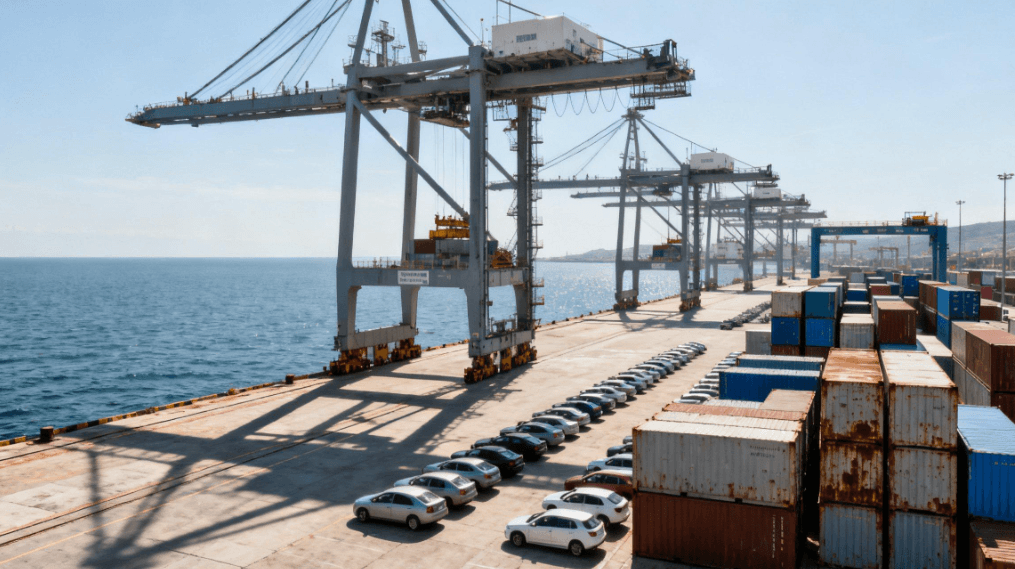 A quick note on the numbers, because they matter here more than on almost any other topic. Freight is volatile. The same lane can be quoted at very different rates and very different transit times depending on the week, the carrier, the routing and whatever is happening at the Suez Canal or on the Caspian ferries. We give you ranges, we flag where sources spread, and we treat every figure as a reference point to confirm, not a price to bank on. Think of what follows as a map of how the trip works, then get a live quote for your specific car and week before you commit a dollar.
Why there is no direct route, and what that actually means
Georgia sits on the Black Sea, which feels close to everywhere until you try to reach it from East Asia by water. There is no direct container service from China to the Georgian ports, so an ocean box does not travel in one leg. It is loaded at a Chinese port, sails west and through the Suez Canal, then gets transshipped at a Mediterranean or Black Sea hub, commonly Istanbul, Constanta or Piraeus, before a feeder vessel carries it the last stretch into Poti or Batumi. That transshipment is the reason a single quoted "transit time" can swing by weeks, because it depends on how the connection at the hub lines up, and it is why the honest answer to "how long does it take" is a window rather than a number.
This is not a problem to solve, it is just the shape of the route, and knowing it changes how you read every quote. When one forwarder says 28 days and another says 45 for what looks like the same lane, they are usually describing the same Suez-plus-transshipment path with different assumptions about the hub connection and the market. It also sets up the one genuinely strategic choice on this trip, the choice that the forwarder blogs tend to skip because they only sell the boat. You do not actually have to go by sea at all.
Sea or rail? The two ways across
Most people never learn there is a second way to move a vehicle from China to the Caucasus, because the search results are wall-to-wall ocean freight. But there is a land route, and for the right shipment it is faster and more schedule-predictable than the boat. The decision between them is the real fork in this trip, so it is worth understanding both before you default to sea out of habit.
Ocean via Suez: cheaper, slower, the default
The sea route is the default for a reason. It is generally the cheapest way to move a car from China to Georgia, and it carries the most volume, so capacity and forwarders are easy to find. The trade-off is time and variability. Port-to-port runs roughly 25 to 45 days, with sources spreading across that band because of the Suez passage and the transshipment connection at the Mediterranean or Black Sea hub. Departures are the usual Chinese gateways, Shanghai, Ningbo and Qingdao, and the box lands at Poti in the great majority of cases because that is where the container handling is. Sea is the right call when cost is the priority and the timeline has slack, which describes most used-car shipments.
Rail on the Middle Corridor: faster, pricier, watch the Caspian
The land alternative runs on the Trans-Caspian route, also called the Middle Corridor. The cargo moves by rail from China across Kazakhstan, crosses the Caspian Sea by ferry, then continues through Azerbaijan into Georgia. The headline advantage is speed: rail can reach the Georgia region in roughly 12 to 20 days, which can come close to halving the sea window, and the schedule tends to be more predictable than an ocean transshipment. The catch sits in the middle of the route, at the Caspian crossing, where ferry capacity is the bottleneck and backlogs have been reported, including congestion at Aktau in 2025. Rail also costs more, commonly cited around 5K to 7K USD per 40ft. Choose rail when time genuinely matters and the budget can carry the premium, and price in the chance of a ferry-side delay.
Here is the trade-off in one view. Treat the figures as indicative ranges that move with the market, not quotes.
| Route | Indicative transit | Indicative cost (per 40ft) | Reliability | Best when |
|---|---|---|---|---|
| Ocean via Suez | ~25 to 45 days | wide band, often ~2K to 8K USD depending on market and routing | Variable, depends on transshipment connection | Cost is the priority, timeline has slack |
| Rail, Middle Corridor | ~12 to 20 days | commonly ~5K to 7K USD | More schedule-predictable, but Caspian-ferry backlogs possible | Speed matters and budget can carry the premium |
RoRo or container?
Once you have settled sea versus rail, the next choice is how the car rides. On the ocean leg this comes down to roll-on roll-off versus a shipping container, and the two suit different cars. RoRo means the car is driven onto a dedicated vehicle vessel and parked, which makes it the cheaper option and the natural fit for a running, registered, standard car. A container means the vehicle is loaded into a 20ft or 40ft box, which costs more but gives full enclosure, protection from weather and handling, and the ability to ship a non-running or high-value car. The practical rule most exporters follow is simple. Send an ordinary running car by RoRo to save money, and reach for a container when the car is high-value, non-running, or needs the extra protection.
Why EVs and hybrids usually go in a container
Electric and hybrid cars are the clear exception to the save-money-with-RoRo default, and it is worth knowing why before you book. A high-voltage battery pack is treated as dangerous goods in ocean transport, which brings special handling and documentation requirements, and carriers generally prefer, or require, that these vehicles travel enclosed in a container rather than open on a RoRo deck. The battery protection and the paperwork are the reason, not a sales upsell. The rules here are real and they change, so if you are moving an EV or a plug-in hybrid, confirm the current dangerous-goods and carrier requirements for that specific car and battery before you book, rather than assuming it ships like a petrol car. This is also where a China-side source that already holds the battery and condition documentation saves you a scramble at booking.
Here is the method choice at a glance.
| Method | Indicative cost | Suitability | EV / hybrid |
|---|---|---|---|
| RoRo | Cheaper | Running, registered, standard cars | Generally not preferred for high-voltage batteries |
| Container (20ft / 40ft) | Higher | High-value, non-running, or extra protection | Usually the required or preferred choice, battery handling and documentation |
Poti or Batumi? Picking the right Georgian port
Georgia has two seaports that matter for cars, and they are not interchangeable, so the choice deserves a moment. Poti port car shipping is the default for vehicles, and for good reason. Poti is Georgia's largest port and handles roughly 80% of the country's container traffic, which makes it the dominant auto-import gateway, and car-container volumes there were up around 12% over the first nine months of 2025 . If you are shipping a container of cars, Poti is almost certainly where it lands, simply because that is where the container infrastructure, the handling capacity and the customs flow for vehicles are concentrated.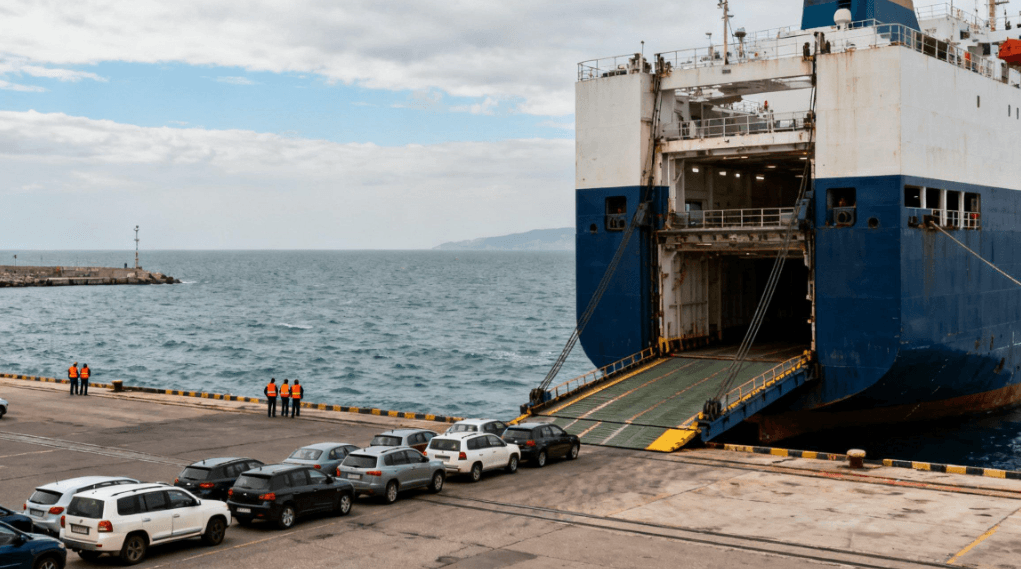 The Batumi port is the secondary option, and it plays a different role. Batumi is RoRo-capable and a working port, but its container operations are lighter than Poti's, with capacity in the region of 230,000 to 300,000 TEU, and its cargo mix leans more toward oil, dry bulk and general cargo than toward car containers. For most used-car shipments the answer is Poti, and Batumi enters the picture mainly when a specific service, schedule or onward route favors it. Let your forwarder confirm which port your chosen sailing actually calls, because the routing, not a preference, usually decides it.
Time and cost, end to end
Pulling the pieces together, the honest picture is a set of ranges rather than a single landed number, and the spread is driven by choices you now understand. Method is the first lever: a RoRo slot is cheaper than a container, and a container is cheaper than rail. Route is the second: sea is the budget path, rail buys speed at a premium. On the ocean side, a container from China to Poti has been quoted across a wide band, often somewhere around 2K to 8K USD depending on the market, the routing and whether it is a 20ft or 40ft box, with a 20ft frequently landing in the lower part of that range. Rail on the Middle Corridor sits higher, commonly cited around 5K to 7K USD per 40ft, in exchange for the shorter transit. On top of the freight, budget for the things that are easy to forget, marine insurance, port handling and documentation at origin and destination, and any inspection or fees on arrival.
| What you are shipping | Typical method | Indicative transit | Indicative cost note |
|---|---|---|---|
| One running standard car, cost-led | RoRo, sea via Suez | ~25 to 45 days | The cheapest path, add insurance and handling |
| High-value, non-running, or EV / hybrid | Container, sea via Suez | ~25 to 45 days | Higher than RoRo, wide market-driven band |
| Time-critical shipment | Container by rail, Middle Corridor | ~12 to 20 days | Around 5K to 7K USD per 40ft, premium for speed |
The single most useful habit on this trip is to get two or three live quotes for your exact car, week and method, then read them against the ranges above so a number that looks high or suspiciously low stands out. Rates this volatile reward a quick comparison far more than they reward loyalty to one forwarder.
What happens when the car lands
Shipping ends at the quay, but the car's journey does not. Once it lands at Poti or Batumi, the vehicle enters Georgian customs, and from there one of two things happens. Either it is cleared for use inside Georgia, which brings excise and the country's current import terms into play, or it is re-exported onward, because Georgia is the open re-export hub for the wider region and a large share of imported vehicles move on to Caucasus and Central Asia buyers rather than staying in the country. Both paths follow Georgian customs rules and, for a re-export, the destination country's rules as well, and both sit outside the shipping leg this guide covers. We walk the clearance and excise side in detail in our companion Georgia used-car import rules guide, and the bigger trade-flow picture, why so many cars pass through Georgia and where they go next, in our Georgia used-car trade hub overview. If you are weighing Georgia against other destinations for China-origin stock, our cross-region export comparison lays Poland, Georgia and Algeria side by side.
Shipping an inspected car from China, through Guazi
Once you know how the route works, the part worth getting right at the source is the car itself, and that is where sourcing from China the right way pays off. Guazi is one of China's largest used-car platforms, and the export side is built to put a sound, documented vehicle on the boat rather than leaving you to gamble on condition from the other side of the world. Every car carries an over 200-point inspection and a full condition report, so the build date, history and state of the vehicle are verified data you can act on, which matters when a battery document or a precise spec decides how it ships. On the logistics side, Guazi's stated network runs to 4,000+ shipping routes with both container and RoRo options and a 30 to 45 day port-to-port window, in line with the sea ranges above (Guazi).
We are precise about the role, because overstating it would be wrong on a logistics piece. Guazi is the China-side supplier of the inspected car and its export documentation, not your carrier and not your clearing agent at the Georgian port, so the booking specifics and the local clearance stay with your forwarder and broker. What we handle well is the part we are built for: a verified, correctly documented car, matched to the right shipping method, leaving China with its condition report and paperwork in order. Pick the route, then let the inspection decide the car. Browse export-ready inspected cars.
Key Takeaways
- There is no direct boat from China to Georgia, so shipping a car from China to Georgia by sea means a Suez passage plus a transshipment at a Mediterranean or Black Sea hub, which is why transit times come as a window, roughly 25 to 45 days.
- The real fork is sea versus rail. Ocean is cheaper and the default, rail on the Middle Corridor is faster at around 12 to 20 days but pricier and exposed to Caspian-ferry backlogs.
- RoRo is the cheap method for a running car, a container is for high-value, non-running, or extra protection, and EVs and hybrids usually need a container for battery handling.
- For Poti port car shipping, Poti is the default, handling around 80% of Georgia's containers, while the Batumi port is the lighter secondary option that matters only when a specific service favors it.
- Every freight figure here is an indicative, market-driven range, so get two or three live quotes for your exact car, week and method before booking.
One more time, because it matters. Freight rates and transit times on this lane move constantly with the market, the Suez routing and the Caspian ferries, so every number above is an indicative 2025 to 2026 range, not a Guazi quote. Request a current quote before booking, and remember Guazi is the China-side car supplier, not your carrier or your customs broker at Poti or Batumi. Confirm the live rate, routing and any EV requirements with your forwarder before you commit.
Sources & References
- UCS / US-China Shipping, shipping from China to Georgia
- Sino Shipping, shipping from China to Georgia
- Basenton, China to Georgia shipping rates
- WCShipping, RoRo vs container shipping to Poti
- Georgia Today, Poti and Batumi ports 2025 performance
- RailFreight, Middle Corridor growth










About Us
Get Support
Follow Us


Copyright © 2015~2026 https://en.guazi.com/, Chongqing Guazi Enterprise Consulting Service Co., Ltd. All rights reserved.