


Guazi
GlobalEnglish


Ghana Duty for Sedans: 2026 GRA Rates and Real Examples
Article OverviewCheck Ghana sedan import duty in 2026 with the correct petrol and diesel engine bands, overage rules, VAT method and worked buying examples.
- Quick answers
- Which engine-size band will my sedan land in?
- What the full landed cost includes
- Worked example 1: Toyota Corolla 2018, 1.8L
- Worked example 2: Toyota Camry 2019, 2.5L
- How do you read the Transaction Price Database?
- Sedan-specific sourcing considerations
- Avoid these common sedan import mistakes
- Key takeaways
- Summary
Pricing note: The tables below use GRA's current published petrol and diesel passenger-car bands. Confirm the exact fuel, engine capacity and classification in ICUMS.
Quick answers
1. What are the petrol bands?
Petrol cars are charged at 5% up to 1,000 cc, 10% above 1,000 cc up to 3,000 cc, and 20% above 3,000 cc.
2. What are the diesel bands?
Diesel cars are charged at 5% up to 1,500 cc, 10% above 1,500 cc up to 2,500 cc, and 20% above 2,500 cc.
3. Is 15% a standard middle sedan band?
No. The current GRA passenger-car table used for this guide does not show a standard 15% middle band.
4. What else affects the bill?
The final bill also depends on Customs value, vehicle age, VAT, levies, overage, classification and the live ICUMS calculation.
5. Does engine size determine the overage penalty?
No. Fuel type and engine size affect the duty band. The overage penalty is a separate charge based on the vehicle’s age and category.
Two sedans can look almost the same and still attract different import charges in Ghana. Fuel type, engine size, Customs value, and age all affect the bill. This guide explains the current petrol and diesel bands, then uses Corolla and Camry examples to show what buyers should check before they rely on a duty estimate.
Sedan duty is the most predictable part of the Ghana schedule, right up until an engine-band step or a price-database flag adds a bill you did not budget for.
Ghana’s new vehicle standards use the shipment date. Used vehicles shipped before 1 October 2026 are exempt, even if they arrive later. For shipments from that date, the importer, dealer or distributor must register with the GSA Vehicle Homologation Unit. Each used vehicle also needs an approved inspection in the country of origin and a Certificate of Conformity before shipping.
Covered used vehicles cannot be more than 15 years old. The rules also block flood-damaged or fire-damaged vehicles, vehicles built from spare parts, vehicles without a kilometre-per-hour speedometer, and vehicles with serious damage to the chassis or safety cage.
The 15-year limit is separate from Customs overage. Passenger cars have no overage penalty up to 10 years, a 5% CIF penalty above 10 and up to 12 years, and a 20% CIF penalty above 12 and up to 15 years. Other vehicle types use different bands.

Which engine-size band will my sedan land in?
Use the exact fuel type and engine size, not a remembered percentage. The GRA vehicle-importation table is the official starting point. The Guazi import-mistakes guide explains why guessing the band can spoil the full budget.
GRA does not rely on the seller’s invoice alone. Its method starts with the manufacturer’s first purchase price, applies age-based depreciation, converts the value into Ghana cedis, and adds freight and insurance to form CIF. Import duty is then based on CIF and the vehicle’s Customs classification.
| HS 8703 passenger car | Engine capacity | Published import duty |
|---|---|---|
| Petrol | Up to 1,000 cc | 5% |
| Petrol | Above 1,000 cc to 3,000 cc | 10% |
| Petrol | Above 3,000 cc | 20% |
| Diesel | Up to 1,500 cc | 5% |
| Diesel | Above 1,500 cc to 2,500 cc | 10% |
| Diesel | Above 2,500 cc | 20% |
From 1 January 2026, VAT is 15%, NHIL is 2.5% and the GETFund Levy is 2.5%. GRA says all three use the same applicable base. The assessment may also include AU, ECOWAS, EXIM and Special Import levies, plus a 1% examination fee for a used vehicle. Use the live ICUMS result for the exact car.
What the full landed cost includes
For a full business-cost view, compare this calculation with the Guazi dealer landed-cost guide. Convert dollar inputs with a dated rate from the Bank of Ghana, not an old WhatsApp quote.
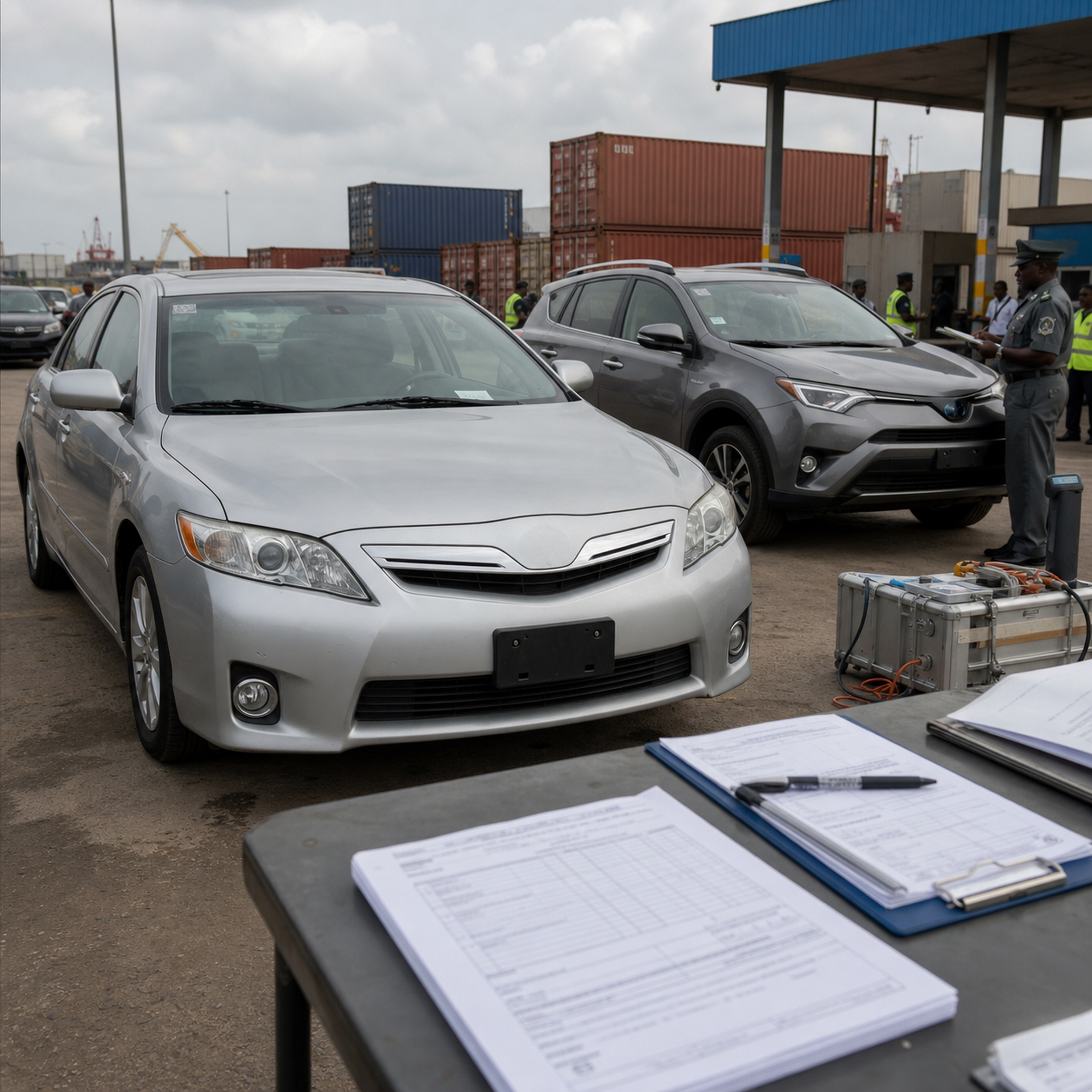
Worked example 1: Toyota Corolla 2018, 1.8L
A 1.8-litre petrol Corolla falls in the current 10% band. In this example, a CIF of GHS 95,000 gives an indicative import duty of GHS 9,500. That is not the final amount. The buyer must still add the other ICUMS lines, conformity costs, clearing, registration and delivery.
| Cost line | 2018 Toyota Corolla 1.8L | Buyer check |
|---|---|---|
| Example CIF | GHS 95,000 | Confirm the Customs-accepted CIF for the exact VIN |
| Published petrol duty band | 10% for above 1,000 cc to 3,000 cc | Confirm passenger-car classification and engine specification |
| Indicative import duty | GHS 9,500 | Example CIF multiplied by 10% |
| VAT, NHIL and GETFund | Current assessment | Use 15%, 2.5% and 2.5% on the applicable 2026 base |
| Other charges and overage | Current assessment | Add every applicable ICUMS line and calculate age separately |
| Conformity and destination | Current quotations | Include approved inspection, CoC, port, clearing, registration and delivery |
The tax burden lands at about 31.3% of CIF.
Use the live ICUMS assessment and current quotations to complete the total. Do not treat the GHS 9,500 duty line as the full import bill.
Worked example 2: Toyota Camry 2019, 2.5L
A 2.5-litre petrol Camry is in the same 10% band. With the example CIF of GHS 135,000, the indicative import duty is GHS 13,500. The larger bill comes from the higher CIF, not a different engine band.
| Cost line | 2019 Toyota Camry 2.5L | Buyer check |
|---|---|---|
| Example CIF | GHS 135,000 | Confirm the Customs-accepted CIF for the exact VIN |
| Published petrol duty band | 10% for above 1,000 cc to 3,000 cc | Confirm passenger-car classification and engine specification |
| Indicative import duty | GHS 13,500 | Example CIF multiplied by 10% |
| VAT, NHIL and GETFund | Current assessment | Use 15%, 2.5% and 2.5% on the applicable 2026 base |
| Other charges and overage | Current assessment | Add every applicable ICUMS line and calculate age separately |
| Conformity and destination | Current quotations | Include approved inspection, CoC, port, clearing, registration and delivery |
The tax burden lands at about 37.1% of CIF.
Complete the calculation with the live ICUMS assessment, current conformity costs and destination charges for the exact vehicle.
How do you read the Transaction Price Database?
Use the GRA or ICUMS result as the main planning figure for the exact car. If Customs does not accept the declared value, it may set another value under its valuation process. Keep the invoice, freight, insurance, and vehicle details ready to support the assessment.
Sedan-specific sourcing considerations
- For a Corolla, Camry or another sedan, check the exact engine, fuel type, gearbox history, cooling system, dashboard codes, structural repairs, mileage and tyre condition. A clean respray or attractive dealer photo does not prove the car is sound.
- Use the condition report to decide whether to buy. For a covered shipment, complete the separate GSA-approved inspection and obtain the Certificate of Conformity before shipping.
Sourcing decisions also set up the one risk a price database cannot price, which is the mechanical state of the specific car. A used sedan hides a worn automatic or a past accident behind a clean respray, and a verified report is the most direct way to see through it. Guazi runs an inspection of over 200 points into a digital condition report and cross-checks the car's insurance and maintenance records to flag accident and flood history, which answers the question a dealership photo never can: whether this particular Corolla or Camry is as sound underneath as it looks on the lot.
Avoid these common sedan import mistakes
- Using one engine table for both petrol and diesel
- Applying a 15% middle import-duty band that is not in the current published passenger-car table
- Calculating VAT, NHIL and GETFund without the current 2026 method
- Treating the seller's invoice as the final customs value
- Calling 10 years an import ban
- Shipping a covered vehicle without approved inspection and CoC
- Ignoring gearbox, cooling or accident-repair evidence
Key takeaways
- Select the duty band from both fuel type and exact engine capacity.
- Use the published engine band and current 2026 VAT method in every estimate.
- Calculate overage separately from engine-based import duty.
- Compare Corolla and Camry units on condition, accepted CIF and total ownership cost.
Summary
Start with the sedan’s fuel type and exact engine size. Then add the accepted CIF, current taxes and levies, any age-based overage, conformity costs and destination charges. A Corolla and Camry can share the same duty rate but still have very different final costs because their CIF values and condition are different.
Looking to source an inspected used car from China? Browse Guazi's export-ready inventory







About Us
Get Support
Follow Us


Copyright © 2015~2026 https://en.guazi.com/, Chongqing Guazi Enterprise Consulting Service Co., Ltd. All rights reserved.