


Guazi
GlobalEnglish


Ghana Car Import Cost Breakdown 2026: Build the Budget Before You Buy
Article OverviewCalculate a Ghana used-car landed cost from purchase through inspection, freight, Customs, Tema clearing, delivery, and first repairs. Includes 2026 rules.
- Quick answer: what belongs in the landed cost?
- Check eligibility before you price anything
- The seven cost envelopes
- Vehicle purchase and origin costs
- Pre-shipment compliance and inspection
- Freight and marine insurance
- Ghana customs assessment
- VAT and other customs lines
- Tema port and clearing costs
- Registration and inland delivery
- First repairs and risk reserve
- The evidence sheet behind a reliable estimate
- Why the 1.5× shortcut fails
- A blank landed-cost worksheet
- Stress-test the figure before you pay
- Common budgeting mistakes
- How Guazi Gives You an Accurate Landed Cost
- Final Recommendation & Next Steps
- Sources & References
Planning note: “The car will cost about 1.5 times its price” is not a Ghana rule. Use dated quotes and the exact VIN. Customs, freight, exchange rates and destination charges can change the result.
The hard part of importing a used car to Ghana is not finding an attractive price abroad. It is knowing what that car will cost by the time it leaves Tema, reaches your town and is ready for daily use.
A buyer may see a low vehicle price and add a rough duty percentage. That leaves out origin transport, export handling, insurance, inspection, Certificate of Conformance costs, port charges, registration, delivery and the first repair. One missing line is enough to turn a bargain into a cash problem.
This guide gives you a complete cost stack. It also separates the numbers a seller can quote from the amounts only Ghana Customs, an approved inspection route or a local service provider can confirm. That distinction matters because a confident estimate is not the same as an official assessment.
There is no fixed landed-cost multiplier for every car. A small petrol hatchback, a ten-year-old sedan and a newer hybrid SUV can have very different customs values, freight needs and compliance risks. Build the budget line by line first. Decide whether the car is still good value only after the total is visible.
Quick answer: what belongs in the landed cost?
Your full landed-and-ready budget should cover seven envelopes:
- Vehicle purchase and origin costs;
- Pre-shipment compliance and inspection;
- Freight and marine insurance;
- Ghana customs assessment;
- Tema port and clearing costs;
- Registration and inland delivery; and
- First repairs, servicing and a risk reserve.
If an estimate stops at “vehicle + shipping + duty,” it is not yet a complete budget.
Check eligibility before you price anything
A car that cannot legally complete the import process has no useful landed cost. Confirm eligibility before paying for freight.
For vehicles shipped on or after 1 October 2026, the Ghana Standards Authority requires used-vehicle importers to register and each used vehicle to pass pre-export or pre-shipment verification by a GSA-approved inspection body in the country of origin. A Certificate of Conformance must accompany the export documents.
The same framework prohibits used vehicles above 15 years and specified unsafe vehicles. These include flood-damaged or burnt vehicles, cars with serious chassis or safety-cage damage, vehicles assembled from spare parts and vehicles without a speedometer that reads in kilometres per hour.
Vehicles shipped before 1 October 2026 are exempt from the new framework even if they arrive later. The shipment date therefore belongs in the budget file. Read the current GSA vehicle import notices before committing.
The seven cost envelopes
Vehicle purchase and origin costs
Start with the actual purchase price for the exact VIN. Then add every cost required to move the car from the seller to the export point.
- Vehicle price;
- Seller, auction or platform fee;
- Inland transport to the export yard or port;
- Export handling and documentation;
- Bank or payment fees; and
- Any inspection or repair required before export.
Keep the invoice, payment record, and itemised origin statement. Do not accept one unexplained “FOB package” number when you need to know which services are included.
Guazi buyers can use the live used-car inventory to shortlist a vehicle, but the listing price is only the first line of the budget.
Pre-shipment compliance and inspection
From the October 2026 start date, the official GSA inspection and CoC route is a legal compliance step for covered used vehicles. It is not the same as a seller’s condition report.
Budget for the approved inspection fee, CoC handling, any compliant rework, transport to the inspection site and time risk if the car fails. Ask the approved provider what is included. Do not insert a flat amount copied from another shipment.
A commercial condition inspection still matters. It can show accident repair, tyre condition, leaks, warning lights and interior wear before you buy. But it cannot replace the official PVoC inspection or guarantee a CoC.

Freight and marine insurance
Get a written, dated quote for the actual route and shipping method. The quote should state what it covers and what it excludes.
For a single standard vehicle, roll-on/roll-off may be an option. Containers may suit some higher-value or multi-unit shipments. The better choice depends on route availability, vehicle condition, cargo plan, security needs and total price. Do not publish one method as universally cheaper without a live quotation.
Freight matters twice. You pay the carrier, and GRA adds freight and insurance when forming the CIF value used in the customs calculation.
Ghana customs assessment
GRA says a vehicle duty check in ICUMS uses the chassis number or VIN, make, model and year. Its vehicle guidance explains that the calculation starts from the manufacturer’s first purchase price, applies age-based depreciation to reach an FOB value, uses the current exchange rate, then adds freight and insurance.
The path is:
Assessed FOB value + freight + insurance = CIF value
CIF value × applicable import-duty rate = import duty
The purchase invoice is useful evidence, but it may not be the only value used. Budget from the live ICUMS estimate for the exact VIN, not from the price written in a social-media advert.
Engine capacity, fuel type and vehicle classification affect the import-duty rate. For passenger cars, GRA publishes petrol and diesel bands from 5% to 20%. The Ghana sedan-duty guide explains why a petrol Corolla 1.8 and Camry 2.5 can share the same 10% headline rate even though their final duty amounts differ.
VAT and other customs lines
Import duty is not the whole customs bill. Depending on the vehicle and assessment, the customs stack can also include:
- VAT;
- National Health Insurance Levy;
- GETFund Levy;
- African Union Levy;
- ECOWAS Levy;
- EXIM Levy;
- Special Import Levy;
- used-vehicle examination fee; and
- overage penalty where applicable.
- Ghana’s VAT reform took effect on 1 January 2026. GRA states that VAT is 15%, NHIL is 2.5% and GETFund Levy is 2.5%, with all three calculated on the same applicable base. The reform removed the old cascading method.
- GRA’s vehicle page still shows an older 12.5% VAT figure in its historical table, so do not mix that number with the current method. Use the current VAT guidance and the live ICUMS output.
Tema port and clearing costs
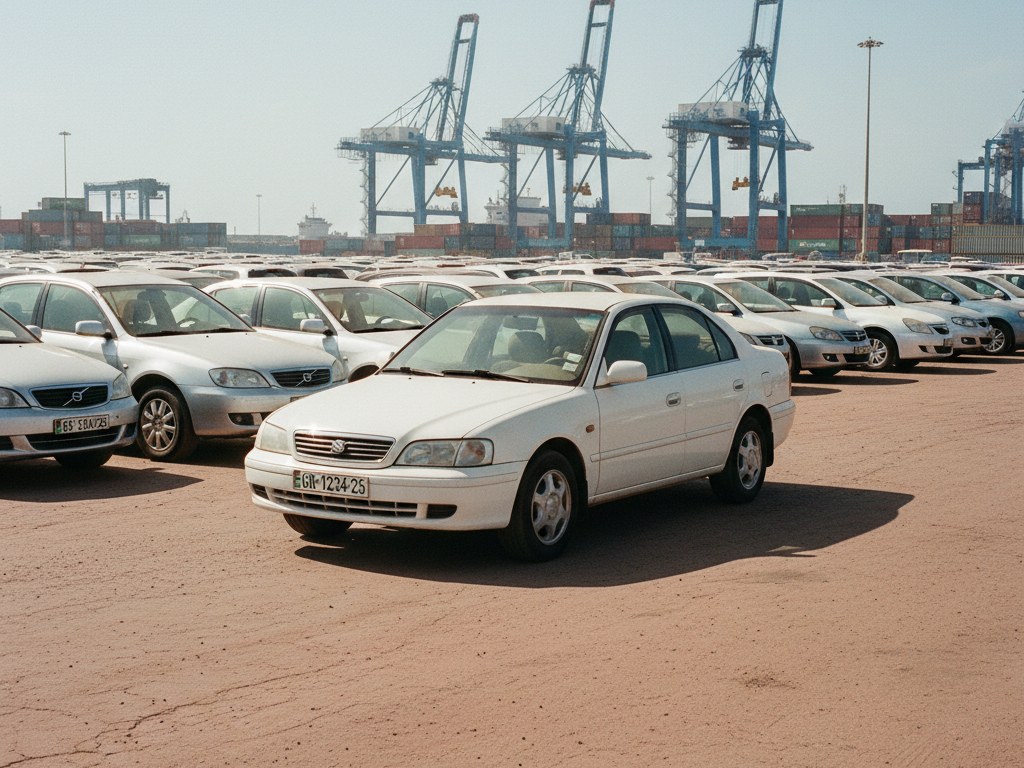
After the customs estimate, ask for a separate destination quote. It should identify the services rather than hiding everything under “clearing.”
- terminal or port handling;
- documentation and release;
- customs agent service where used;
- examination or scanning-related destination costs;
- storage or demurrage exposure; and
- any line not already included in the shipping quote.
- Do not promise that clearance will take a fixed number of days. Timing depends on document readiness, assessment, inspection, port activity and payment. A complete file reduces avoidable delay, but it does not guarantee a release date.
Registration and inland delivery
A cleared car is not automatically ready for the buyer. Add the current registration, plate, insurance and roadworthiness costs that apply to the vehicle.
Then quote delivery from Tema to the actual destination. Accra, Kumasi, Tamale, Takoradi and Wa do not have the same transport cost or timing. Ask whether the car will be driven, carried on a transporter or collected by the buyer. Include fuel, tolls, driver cost and risk where relevant.
First repairs and risk reserve
A used car often needs work even when it is generally sound. Add the service you plan to complete before handing it over or using it:
- Fluids and filters;
- Tyres, battery or brakes where the inspection shows wear;
- diagnostic work;
- Air-conditioning or cooling-system repairs;
- Cosmetic preparation; and
- Parts that should be replaced because service history is missing.
Set the reserve from actual risk. A poorly documented turbocharged car needs a different reserve from a clean, common model with a recent service record. Do not add an unexplained standard percentage and call it accurate.

The evidence sheet behind a reliable estimate
| Cost line | Evidence to collect | Who can confirm it? |
|---|---|---|
| Vehicle and origin | VIN, invoice, payment proof, itemised origin quote | Seller or platform |
| Condition | Inspection report, scan, photos and videos | Independent inspector or verified platform process |
| GSA compliance | Importer registration, approved inspection route and CoC quote | GSA and approved third-party body |
| Freight and insurance | Dated route-specific quote and coverage | Carrier, forwarder and insurer |
| Customs | VIN-specific ICUMS estimate or assessment | GRA or licensed customs professional |
| Port and clearing | Itemised Tema destination quote | Relevant service providers and agent |
| Registration and delivery | Current registration, insurance and city-delivery quotes | DVLA, insurer and transporter |
| First service | Parts and labour estimate tied to inspection findings | Workshop and parts suppliers Date every quote. A budget assembled from numbers collected in different months can be wrong even when each number was once accurate. |
Why the 1.5× shortcut fails
A final cost near 1.5 times the purchase price can happen in one dated case. It is not a rate you can safely apply to another vehicle.
Consider two cars bought for the same amount. One is a common 1.5-litre petrol car with a clear history. The other is an older 3.5-litre petrol sedan that needs tyres and has a weak documentation file. Their customs rate, overage exposure, repair reserve and resale risk can be very different.
The ratio also changes when the vehicle price changes. Fixed costs take a larger share of a cheaper car. A higher-value car may have a lower ratio but a much larger total cash requirement.
Use a multiplier only after the full estimate is complete. It can describe that one scenario; it should never create the budget.

A blank landed-cost worksheet
| Section | Your figure | Date and source |
|---|---|---|
| Vehicle purchase | _____ | _____ |
| Origin fees and transport | _____ | _____ |
| Inspection, PVoC and CoC | _____ | _____ |
| Freight and insurance | _____ | _____ |
| ICUMS customs assessment | _____ | _____ |
| Port and clearing | _____ | _____ |
| Registration and insurance | _____ | _____ |
| Inland delivery | _____ | _____ |
| First repairs and service | _____ | _____ |
| Risk reserve | _____ | Reason: _____ |
| Total landed-and-ready cost | _____ | Checked on: _____ |
Stress-test the figure before you pay
Run at least four checks:
- Exchange-rate check: What happens if the cedi is weaker when Customs or suppliers convert the amount?
- Customs-value check: Does the budget still work if the accepted value is higher than your first estimate?
- Delay check: Can you cover storage, finance cost or missed sales time if release takes longer?
- Condition check: Can you pay for the likely first repair without borrowing emergency cash?
- A dealer should also test the selling price. Expected retail price minus the full landed-and-ready cost, preparation, warranty reserve and selling costs is the margin. The dealer landed-cost guide develops that business calculation in more detail.

Common budgeting mistakes
- Starting with a multiplier. It hides which line is wrong.
- Using the invoice as the customs value. GRA’s vehicle method is more specific.
- Forgetting compliance before freight. A car that cannot obtain the required CoC should not ship.
- Using 12.5% VAT in a 2026 example. The current standard rate is 15%.
- Calling 10 years a total ban. Overage and the GSA 15-year prohibition are different rules.
- Leaving Tema-to-city delivery out. The car still has to reach the buyer.
- Assuming inspection means no repairs. Inspection reveals condition; it does not make wear disappear.
- Mixing dated and undated quotes. The total then has no reliable point in time.
How Guazi Gives You an Accurate Landed Cost
A verified export platform turns the five components into one reliable figure. Guazi exports 35,000+ vehicles a year, with 8,000+ into African markets, and sources 100% from individual owners, so the vehicle price is a real, documented number, and the freight quote is an actual booking, not an estimate.
The Guazi Africa desk provides a duty-inclusive landed-cost estimate: vehicle, freight, indicative GRA duty, clearing, and inland delivery in a single figure for your destination city. The answer to how much to import a car to Ghana is known before you commit, and the bill at Tema is the bill you planned.
Want an accurate landed-cost figure for a specific car?
Connect with a certified Guazi sourcing expert
Final Recommendation & Next Steps
Do not ask only, “How much is the car?” Ask, “What will this exact VIN cost when it is compliant, cleared, delivered and ready to use?”
Collect one itemised figure for every envelope, attach the evidence and date, then run the stress tests. If a seller or agent cannot explain a line, leave it unconfirmed rather than filling the gap with a guess.
A proper landed-cost budget may make some cheap-looking cars unattractive. That is useful. The cheapest mistake is the one you identify before you send money.
Sources & References
- Ghana Revenue Authority: Vehicle importation, valuation method and charge table
- Ghana Revenue Authority: 2026 VAT reform
- Ghana Revenue Authority: VAT Act 1151 guidelines
- Ghana Standards Authority: October 2026 implementation notice
- Ghana Standards Authority: Vehicle import FAQ
- Ghana Customs Act, 2015: vehicle provisions and overage schedule
- Guazi facts (35,000+ annual exports, 8,000+ into Africa, 200+ point inspection, 100% individual-owner sourcing): Guazi About.










About Us
Get Support
Follow Us


Copyright © 2015~2026 https://en.guazi.com/, Chongqing Guazi Enterprise Consulting Service Co., Ltd. All rights reserved.