


Guazi
GlobalEnglish


Makes
Buy It NowAuctionsUp to 160 psPort StockAll VehiclesPopular Makes


Shop By Type


Popular Models


Shop By Budget

Why Tbilisi Runs on the Toyota Prius, and How to Buy a Good Used One
Article OverviewWhy the used Toyota Prius dominates Georgia's roads, what one costs in Tbilisi, how to check the hybrid battery on an ex-taxi, and where the cars come from.
Stand on a kerb anywhere near Liberty Square in Tbilisi for five minutes and count the cars. A good share of them, and most of the taxis, will be the same compact silver hatchback with the long sloping tail. The Toyota Prius is not a statement of green virtue in Georgia. It is the default. It is the taxi you flag on the street, the car your neighbour in Rustavi drives to work, the one parked three-deep outside the supermarket. That ubiquity is the whole reason a used Toyota Prius Georgia buyers keep searching for is one of the most rational cars on the road here, provided you buy the right one and not the tired one.
This guide is about buying the right one. We will start with why the Prius took over Tbilisi in the first place, because the reason is pure arithmetic and it tells you a lot about whether the car suits you too. Then we will look at what a used Prius actually costs across Georgia right now, in lari and dollars, by generation. After that comes the single thing that separates a smart buy from an expensive mistake on this particular car, the health of the hybrid battery, and how to read it on a high-mileage example that has very likely already had one working life. Finally, we will trace where these cars come from, because the supply chain shapes the title and condition you end up holding. Guazi sits in this story as the inspection and battery-health lens, named here at the start and not bolted on at the end.

Why almost every Tbilisi taxi is a Prius
The Prius did not win Georgia on looks or badge appeal. It won on the cost of a litre of petrol, and that is a story any driver in Tbilisi understands in their bones. In mid-2026, 95-octane petrol sits near 3.77 GEL per litre, a little over 1.41 USD, with regular 92 a touch cheaper and diesel higher still around 4.17 GEL. For a working driver covering long days across the city, that number is not a background detail. It is the difference between a profitable shift and a thin one.
This is where Prius taxi Georgia stops being a search phrase and becomes a business decision. A gen-three Prius sips roughly 5 litres per 100 km in the mixed stop-start driving that fills a Tbilisi day. Put that against a conventional petrol saloon burning eight or nine litres over the same distance and the gap compounds shift after shift, month after month. A driver who switches to a Prius is not saving a rounding error. They are clawing back a meaningful slice of every fare, which is exactly why the taxi fleets standardised on it and why the standard cheapest taxi you flag in Tbilisi is so often this car.
The fuel-price arithmetic that put it everywhere
It helps to make the maths concrete. Drive 100 km in a Prius at 5 litres and 95-octane near 3.77 GEL, and your fuel bill is under 19 GEL. The same 100 km in a thirstier petrol car at 9 litres costs you close to 34 GEL. Over a 200 km day that is a 30 GEL gap, and across a six-day week it is the better part of 180 GEL kept in your pocket rather than handed to the pump. Scale that to a year of taxi work and you are looking at thousands of lari. No marketing campaign sells a car the way that running total does, and it sells itself street by street.
The compact body does the rest of the persuading. Old Tbilisi was not laid out for cars, and its lanes, cobbles and tight corners punish anything wide. The Prius slips through them, parks where a crossover cannot, and shrugs off the curb-hopping that city work demands. Cheap to feed and easy to thread through the old town, it became the obvious tool, and once a city's drivers settle on a tool, the second-hand market follows them.
What a decade as Georgia's taxi taught the market about reliability
There is a quieter reason the Prius earned its place, and it only shows up over years. When a model becomes the default taxi, it gets stress-tested in public on a scale no brochure can fake. Hundreds of thousands of hard kilometres, long idling in summer heat, constant restarts, and the cars mostly keep going. That track record built a deep local familiarity. Mechanics in Tbilisi and Rustavi know the platform, know its quirks, and can keep one running without guesswork or a dealer-only diagnostic tool.
That familiarity is worth real money to a buyer. Parts are easy to find because so many of these cars are on the road, and labour is reasonable because no garage is learning the car on your bill. The flip side, which we will not gloss over, is that a car this popular as a taxi is also a car you will very often meet as a high-mileage ex-taxi. The reputation is earned, but it is a reputation for the platform, not a promise about the specific tired example in front of you. Sorting the two is the rest of this guide.
What a used Prius actually costs in Georgia right now
Pricing is where most buyers want a straight answer, so here is one with the honesty the market deserves. A used Prius in Georgia spans a wide band, roughly 4,000 USD for older, higher-mileage units up to 12,500 USD and beyond for newer, cleaner cars, with a clean mid-spec example commonly landing around 8,500 USD. The Toyota Prius Tbilisi price you actually pay depends almost entirely on generation, mileage and how honest the history turns out to be, and the spread inside that band is large enough that knowing where a car sits matters more than the headline number.
The cheapest cars at the bottom of the range are generally older gen-two examples or gen-three cars with serious mileage, often ex-taxis. They can be perfectly serviceable, but the low price is pricing in age and use, and the hybrid battery question looms largest exactly here. The middle of the range buys you a tidier gen-three with believable mileage and a fuller history. The top of the range moves you toward later cars with lower wear and a battery that has more life ahead of it. None of these is automatically the right buy. The right buy is the one whose condition matches its price, and that is a judgement you make car by car, not from a list.
| Generation / age | Typical price (GEL) | Typical price (USD) | What you are buying |
|---|---|---|---|
| Older gen-two, high mileage | ~10,800 to 16,000 | ~4,000 to 6,000 | Cheapest entry, often ex-taxi, battery is the key risk |
| Gen-three, moderate mileage | ~17,500 to 24,000 | ~6,500 to 9,000 | The volume choice, clean mid-spec around 8,500 USD |
| Later gen-three, lower mileage | ~24,000 to 33,500+ | ~9,000 to 12,500+ | Cleaner cars, more battery life remaining |
Treat those figures as a snapshot rather than a fixed tariff. Used-Prius prices move with supply, exchange rates and the time of year, so the bands are there to orient you, not to quote back to a seller. Some owners also point to LPG autogas, far cheaper near 1.75 GEL per litre, as a reason a non-hybrid still pencils out for them, but that is a different car and a different bet. For a Prius buyer the saving is baked into the hybrid drivetrain, and the question is whether that drivetrain is healthy.
The one thing that decides a good Prius from a bad one
Every used car has a headline risk, the one component whose condition swings the whole value. On a Prius it is the hybrid battery, the high-voltage pack that lets the car run on electricity at low speed and recover energy under braking. A Prius with a strong battery is the frugal, smooth, dependable car its reputation promises. A Prius with a tired battery is a car facing a four-figure repair that can rival a chunk of its purchase price. This is the gap between a good buy and a bad one, and on this model it is the gap that matters most.
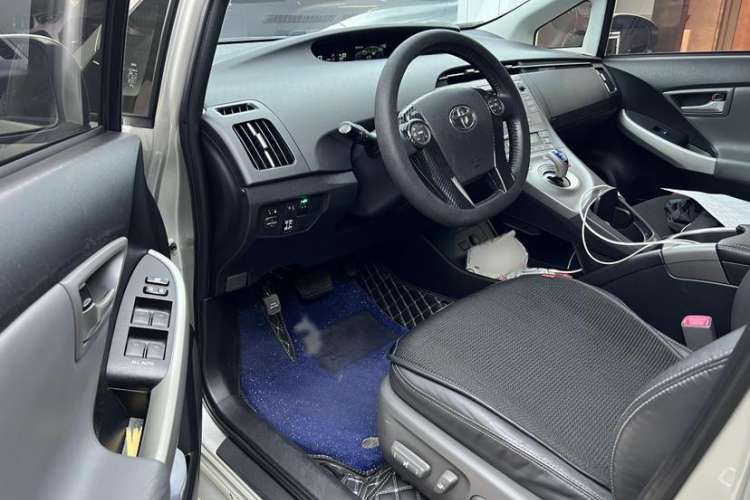
The reason it matters more in Georgia than almost anywhere is the taxi history. A large share of cheap Priuses here have already worked, often hard, before they reach a private buyer, and battery wear tracks use and heat rather than years on a calendar. That is not a reason to avoid the car. It is a reason to inspect it properly, because two Priuses of the same year and price can be in completely different health depending on what their first life looked like.
How to read battery health on a high-mileage ex-taxi
You do not need to be an engineer to take the battery's temperature, you need to know where to look. Start with the car's own hybrid energy-flow display, the screen that shows power moving between engine, battery and wheels. On a healthy car the battery charges and discharges smoothly during a normal drive and the indicated charge does not swing wildly from full to empty in minutes. A pack that lurches between extremes, or that sits pinned at a low state of charge while the petrol engine runs more than it should, is waving a flag. Note, too, whether the engine fires up almost immediately on a gentle pull-away when it is warm, which can hint at a battery no longer carrying its share.
The decisive step, though, is a proper diagnostic read by someone who knows the platform, and Tbilisi has no shortage of those. A hybrid-literate mechanic can pull the battery's block voltages and condition data and tell you whether the cells are balanced and holding, or whether the pack is on borrowed time. This is one inspection it is worth paying for before you buy, not after, because it converts the single biggest unknown on the car into a known. The discipline here is the same one that sits behind a structured used-car inspection, reading verified condition data rather than trusting a clean dashboard and a confident seller.
Mileage honesty: why the odometer needs a second look
The odometer is the second number that decides value, and in this market it deserves a sceptical eye. Odometer rollback is a documented problem across the region, and on an ex-taxi the gap between displayed mileage and real mileage can be large, with buyers caught out losing a meaningful sum on average. A low reading on a car that has clearly lived a hard life should raise a question, not close one.
The fix is cross-checking rather than trusting the dial. Service records, the wear on the pedals and steering wheel, the state of the driver's seat bolster, and any history report you can pull all tell a story the odometer alone might not. Where the numbers and the wear disagree, believe the wear. None of this is about treating every seller as dishonest. It is about treating the displayed mileage as a claim to verify, the same way you would the battery, so that what you pay matches the car you actually get.
Where Georgia's used Priuses come from, and why it matters
To understand the car in front of you, it helps to know how it got to Georgia, because the supply chain leaves fingerprints on the title and the condition. A large portion of the country's used cars, Priuses very much included, arrive through US salvage and wholesale auctions such as Copart, IAA and Manheim, are shipped over, and are then reconditioned and resold, with Rustavi's vast open-air market acting as the country's main clearing house. That route is exactly why so many cars are affordable here, and also why condition varies so widely from one example to the next.
The detail worth holding onto is the title. A significant share of vehicles exported from the US to Georgia carry rebuilt or salvage titles, meaning they were written off somewhere in their past and repaired. A well-repaired salvage car can be a sound buy at the right price, but it is a different proposition from a clean-title car, and the price should reflect that. The chain from importer to reseller to dealer to buyer also stacks margin at each step, commonly 15% to 40%, which is part of why buying with clear eyes on history and condition is how you protect your money rather than just chasing the lowest sticker. For the deeper mechanics of how US-auction sourcing shapes what reaches the country, our companion guide to American and Japanese imports in Georgia goes further.
Buying a used Prius with confidence
When the time comes to commit, the way to buy hybrid car Georgia shoppers can trust is to turn the unknowns into checks and work through them in order. The Prius rewards a disciplined buyer because its risks are knowable, and a short, deliberate routine catches almost everything that turns a bargain into a regret. Run the checks below before money changes hands, not after, and treat any one of them coming back wrong as a reason to renegotiate or walk.
- Battery condition. Get a hybrid-literate mechanic to read the high-voltage pack's block voltages and balance. This is the single most important check on the car.
- Title and history. Confirm whether the title is clean, rebuilt or salvage, and pull whatever auction or history record exists. Price the car for what its past actually is.
- VIN and auction photos. Match the VIN across the car, the documents and any US-auction listing, and look at the original auction photos to see the damage that was repaired.
- Mileage cross-check. Compare the odometer against service records and physical wear. Where they disagree, trust the wear.
- Service and accident records. Look for evidence of regular servicing and any major structural repair. A documented, well-kept car is worth paying more for.
That routine is not about distrust, it is about buying the good Prius rather than the tired one at the same price. Each check converts a question into an answer, and five answers add up to a car you understand before you own it.
How an inspected used hybrid changes the math, with Guazi
Here is where Guazi fits, honestly and within its lane. Guazi is one of China's largest used-car platforms and China's number-one platform for used new-energy vehicles, which means hybrid and electric condition is core competence rather than a sideline. Every car on the platform goes through an inspection of over 200 points feeding a digital condition report, with insurance and maintenance records cross-checked to screen out flood and accident histories, and new-energy cars carry an industry-first 100-day battery-decay guarantee. That battery focus is exactly the anxiety a Prius buyer carries, and it is where the platform speaks with earned authority.
To be clear about the boundary, Guazi does not run a Prius lot in Rustavi and is not your dealer in Tbilisi. What transfers is the discipline, the habit of letting a structured inspection and verified data decide the car instead of a clean dashboard and a good story. Get the battery checked, verify the title and the mileage, and you are buying the Prius the way Guazi inspects one. See inspected used hybrids in stock →
Key Takeaways
- The used Toyota Prius Georgia runs on, dominates Tbilisi because its fuel maths is overwhelming, roughly 5 litres per 100 km against petrol near 3.77 GEL a litre.
- A used Prius spans about 4,000 to 12,500 USD and up, with a clean mid-spec near 8,500 USD; generation, mileage and history decide where a car lands.
- The hybrid battery is the single risk that separates a good Prius from a bad one, especially on a high-mileage ex-taxi.
- Read battery health on the energy-flow display, then confirm it with a hybrid-literate mechanic's diagnostic before you buy.
- Treat the odometer as a claim to verify against wear and records, since rollback is a documented market risk.
- Many cars arrive via US auctions through Rustavi and a notable share carry rebuilt or salvage titles, so confirm the title and price the car for its real history.
Related Stories
- The used hybrids worth buying in Georgia. Where the Prius sits against the Camry Hybrid and RAV4 Hybrid, ranked by use and value.
- Used Ford Transit in Georgia. The work-van case for a small business, running cost and resale.
- American and Japanese imports in Georgia. How US-auction sourcing shapes the cars and titles reaching the country.
Sources & References
- auto.ge, Toyota Prius listings in Georgia
- Autopapa, Toyota Prius used listings
- taxi-tbilisi.com, Toyota Prius taxi fleet
- Wissol, Georgia fuel prices
- og.ge, fuel price guide for Georgia
- lionauto, used cars in Georgia market guide
- wcshipping, shipping salvage cars to Georgia guide
Trying to work out whether a specific used hybrid is sound before you buy?
We can source an inspected used car from China with a full condition report, the same discipline that decides a good Prius from a tired one.







About Us
Get Support
Follow Us


Copyright © 2015~2026 https://en.guazi.com/, Chongqing Guazi Enterprise Consulting Service Co., Ltd. All rights reserved.