

World Cup Special • Save up to $1000 on selected vehicles

Guazi
GlobalEnglish


Nigeria Used Car Import Duty 2026: New Levy Cut, Green Tax, and Real Landed Cost for Dealers
Article OverviewThis guide analyzes 2026 Nigeria used car import costs, focusing on compounding duties, the 12-year age limit, Green Tax, and the VIN valuation system. It helps dealers evaluate real margins.
If you buy used cars from China for Nigeria, the 2026 levy cut is good news, but it is only one line in a longer bill. What decides your margin is the full landed cost after every charge is stacked, not the headline rate. This guide shows how to read that full picture before you commit to a unit.
Source Quality Used Cars From China's #1 Auction Platform
Access 200,000 verified vehicles monthly. Bid in real-time and secure bulk inventory at highly competitive market rates.
2026 Update Summed Up: From 1 July 2026, Nigeria cut the import levy on used vehicles from 15% to 5% of CIF (new vehicles from 20% to 10%) under the 2026 Fiscal Policy Measures. A new Green Tax now adds 2% for engines of 2,000–3,999cc and 4% for 4,000cc and above. Engines below 2,000cc, electric vehicles, mass-transit buses, and locally made vehicles pay no Green Tax. The base 20% import duty is unchanged
What Dealers Must Confirm Before Calculating Import Cost in Nigeria
Before a dealer starts working out duty, freight, or expected margin, the first step is to confirm that the vehicle still passes the initial screening for the Nigeria market. Import cost only becomes meaningful after that first check, because not every unit that looks attractive at source will still make sense to evaluate further.
Why the 12-year rule must be confirmed before any price discussion
Nigeria’s updated import‑duty reduction makes landed‑cost planning easier, but the 12‑year age limit is still one of the first filters that decides whether a vehicle is even worth pricing. Age eligibility shapes the entire buying window, shipment timing, and clearance risk. It’s not just a compliance detail; it’s a practical sourcing variable that affects every step of the process.
As a vehicle gets close to the 12‑year cutoff, the buying window tightens. Shipment schedules become less flexible, export paperwork must move faster, and Lagos clearance leaves far less room for delay. A borderline unit may still look buyable on FOB price, but it carries less operational margin than a newer unit in the same class.
With Nigeria’s new duty reduction, more vehicles now fall into a favorable cost range. But duty savings do not change age eligibility. Dealers still need to screen inventory by year first, then evaluate cost. A unit that barely meets the age rule may qualify for lower duty, yet still introduce timing risks that affect vessel booking, export documentation, and final clearance.
Nigeria Used Car Import Duty Is More Than a Single Tax Rate
Ask any clearing agent in Lagos, and they will say the same thing: dealers who show up at the port with only a duty rate in their head are always the ones caught off guard by the final bill. Nigeria's import cost for used vehicles is not a single charge. It is a structure, and every layer in that structure is calculated differently. Miss one base, apply one rate to the wrong figure, and the entire estimate shifts. That is not a small problem when you are working on thin margins, and the vehicle is already on the water.
The main cost layers behind Nigeria used car import cost
Nigeria's used car import cost is built from five separate statutory charges, each calculated on a different base. Getting one base wrong means the entire estimate is off, because these charges do not simply add up in parallel. They compound.
Under the framework aligned with the ECOWAS Common External Tariff and updated by the 2026 Fiscal Policy Measures (effective 1 July 2026), the charges are:
| Charge | Rate | Calculated On | Key Note |
|---|---|---|---|
| Import Duty | 20% | CIF value | Confirmed rate for used passenger vehicles under ECOWAS CET 2022-2026 |
| NAC Levy | 5% | CIF value | Cut from 15% on 1 July 2026 for used vehicles. New vehicles cut from 20% to 10% |
| Green Tax | 0%, 2%, or 4% | Engine size band | New in 2026. 2% for 2,000–3,999cc, 4% for 4,000cc and above. Below 2,000cc, EVs, mass-transit buses and locally made vehicles are exempt |
| Surcharge | 7% | Import Duty amount only | Applied to the duty figure, not to CIF. Commonly miscalculated in early estimates |
| ETLS | 0.5% | CIF value | ECOWAS Trade Liberalisation Scheme levy, mandatory on all imports |
| CISS / FOB Levy | 1% CISS or 4% FOB | FOB value | Current enforcement status has been inconsistent since 2025. Confirm the applicable charge with your clearing agent before finalizing any estimate |
| VAT | 7.5% | CIF + all above charges combined | VAT is not charged on CIF alone. It sits on top of the full stacked total, which is why it consistently comes in higher than dealers expect |
The headline change is the NAC levy. For a used vehicle, duty plus levy now equals about 25% of CIF, down from about 35% before 1 July 2026. Three details still trip dealers up. First, the surcharge is 7% of the duty amount, not of CIF. Second, the CISS and FOB levy sit on FOB value, so freight and insurance do not touch that line. Third, VAT is charged on every layer stacked together, which is why the final bill runs higher than a back-of-envelope guess.
How all of these charges translate into real numbers on an actual shipment is shown in the case breakdown below.
Watch the Green Tax offset. The levy cut helps every used vehicle, but on a big-engine SUV the new 2% or 4% Green Tax claws some of it back. A 1.5L crossover keeps the full saving. A 4.0L V8 does not. Match the engine size to the charge before you promise a landed price.
Why the duty rate alone does not tell the full import cost in Nigeria
What most dealers do not realize until they are standing in front of a port clearance bill is that Nigeria Customs does not use your purchase invoice to calculate duty. The Nigeria Customs Service runs an automated VIN valuation system that assigns its own fixed dollar value to every imported vehicle based on year, make, model, and VIN. That system-generated figure, not your transaction price, is the base on which every statutory charge is calculated.
The gap between what you paid and what Customs thinks the vehicle is worth can be substantial. A clearing agent quoted by Naira metrics in August 2025 reported that clearing costs on a 2016 Mercedes GLE had jumped from a typical NGN 4 to 5 million to NGN 10 million following the reintroduction of VIN valuation. That kind of gap does not show up anywhere in a duty rate schedule. It only appears when the NCS system generates its own valuation for your specific VIN, and by that point the vehicle is already at the port.
How a Higher Customs Assessment Can Change the Import Outcome
Even with lower rates, the base matters. Nigeria customs can assess value on its own basis, which may sit above your invoice CIF. When that happens, every percentage in the table applies to a higher number. That is the point where a dealer should move from rough screening to a full landed-cost estimate before buying.
| Comparison Item | Scenario A: Based on Supplier Invoice | Scenario B: Based on Higher Customs Assessment |
|---|---|---|
| Vehicle purchase price | Same vehicle, same transaction price | Same vehicle, same transaction price |
| Customs assessment base | Closer to invoice level | Higher than invoice level |
| Import duty exposure | Lower | Higher |
| NAC levy exposure | Lower | Higher |
| VAT base after stacked charges | Lower | Higher |
| Estimated landed-cost pressure | Lower | Higher |
| Margin room for the dealer | Wider | Tighter |
For dealers sourcing from China, this creates a practical blind spot. Two vehicles with the same FOB price can produce very different customs bills if the NCS database value for one model sits higher than the other. The duty rate applied to both is identical. The difference comes entirely from valuation, which is outside the dealer's control once the shipment is moving.
This is why experienced importers treat customs valuation as a cost variable that needs to be estimated before purchase, not discovered at clearance. Working backward from a realistic NCS-assessed value gives a far more reliable picture of margin than working forward from FOB price alone.
Dealers who want a broader view of the full sourcing and export process before focusing on Nigeria-specific valuation can also read our guide on how to import used cars from China to Africa.
When dealers should move from rough screening to full landed-cost estimation
There is a point in every sourcing conversation where a ballpark figure stops being useful. That point is the moment a vehicle clears the initial eligibility check and the sourcing price looks workable on the surface. What comes next is not negotiation. It is verification.
Full landed cost estimation needs to happen before any deposit is committed, because the variables that matter most, customs valuation, exchange rate at the time of clearance, and port-level charges, are all outside a dealer's control once payment is made and the shipment is moving. A vehicle that passes a rough screen can still fail a full cost check, and finding that out after the fact is an expensive way to learn it.
The case in the next section shows what a full landed cost estimate looks like on a real shipment, worked through from FOB price to final dealer economics, using actual transaction data.
Why the Lowest FOB Price Is Not Always the Best Nigeria Deal
A low FOB price only wins if it survives the full stack. China's used-car FOB pricing often leaves more margin room than Japan or the US on comparable units, but the winner is the vehicle that still works after duty, levy, Green Tax, and VAT are added, not the one that looked cheapest at source.
Why China's Lower FOB Pricing May Leave More Margin Room Than Japan or the US
Not every source market performs the same way once a vehicle clears customs in Lagos. The comparison above shows the numbers. What follows is the logic behind them.
According to official trade data from Nigeria's National Bureau of Statistics, reported by BusinessDay Nigeria in December 2025, the United States accounted for approximately 41% of Nigeria's total passenger car import value in the first nine months of 2025. At the brand level, Japanese vehicles hold close to 60% of the sedan and SUV market. China does not yet rank among the top three direct source countries in NBS statistics, but its presence in the Lagos market is growing steadily alongside improving brand recognition and competitive FOB pricing.
These numbers reflect historical sourcing patterns. They do not tell a dealer which market produces the best economics today after landed cost is applied. That requires a different calculation entirely.
The US dominates import volumes for a reason. NCS valuation benchmarks for American-sourced vehicles are well established, which gives dealers a reliable base for pre-purchase cost modelling. The constraint is entry price. At the FOB levels documented by BR Logistics and FreightAmigo, the margin window on US-sourced units is narrower before duty and clearing charges are stacked on top.
Japan's challenge is structural, not just financial. Nigeria mandates left-hand drive only, and the Japanese domestic market is right-hand drive. That single requirement shrinks the available pool and raises the effective price floor before any other cost variable is considered.
China's advantage is at the FOB level, where entry prices are meaningfully lower than either alternative. The open question for dealers is NCS valuation on newer Chinese models, where database benchmarks are still developing. That uncertainty does not eliminate the margin opportunity. It means the homework needs to happen before purchase, not after the shipment is moving.
The dealer who wins on source market selection is not the one who finds the cheapest FOB price. It is the one who works backward from a realistic NCS-assessed landed cost to a maximum viable purchase price at source, and then finds a unit that fits inside that number.
The table below shows how China, Japan, and the US can create different landed-cost and margin conditions for Nigeria-bound dealers assessing used sedans and compact SUVs.
| Source Market | Typical FOB Range | Freight to Lagos | Transit Time | LHD Fit for Nigeria | NCS Valuation Familiarity | Main Dealer Advantage | Dealer Constraint |
|---|---|---|---|---|---|---|---|
| China | USD 5,000-8,000 | USD 1,500–2,000 | 25–30 days | Strong | Developing | Lower FOB entry can leave more room for margin | More valuation homework is needed before purchase |
| Japan | USD 8,000-13,000 | USD 1,800–2,500 | 30–35 days | Limited | More familiar | Strong resale acceptance on established models | Left-hand-drive supply is more limited, which raises the effective entry floor |
| United States | USD 7,000–12,000 | USD 1,200–1,700 | 18–28 days | Strong | More familiar | Broad model supply and more established valuation patterns | Higher source prices can tighten margin faster after landed cost |
Note: FOB and freight figures are indicative market-reference ranges rather than official published benchmarks. Final dealer economics still depend on model-level customs valuation, freight timing, and resale conditions in Lagos.
A Real Lagos Bound Vehicle Cost Case from Guazi Transaction Data
This section uses a real Guazi shipment case to show how a Nigeria bound order should be evaluated before a dealer commits to purchase. The value of a real case is not only that it shows a source price. It shows how an actual order is structured at shipment stage, what can already be confirmed from live transaction data, and where margin risk still remains before the vehicle reaches Lagos. In this case, the confirmed inputs come from a real Guazi order file rather than a hypothetical example, which makes the cost logic more useful for dealers who need to test a vehicle before they buy.
Vehicle profile and shipment route in this real Lagos case
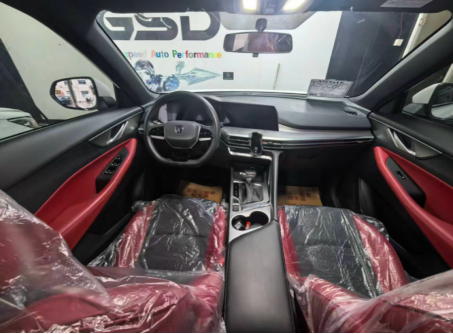
The vehicle in this case is a Changan CS35PLUS 2023 Model Comfort Edition 1.4T DCT Luxury Type, gasoline, booked for shipment from Taicang, China to Lagos, Nigeria. These details matter because landed cost work only becomes meaningful when the exact vehicle profile and shipping route are clear. Dealers do not calculate import economics on a generic SUV category. They calculate them on a specific unit, with a specific model year, trim, fuel type, and destination. That is what turns a rough sourcing conversation into a decision level cost review.
This order also reflects a real commercial stage rather than a cleaned up after the fact example. According to the internal transaction note, the vehicle was still waiting for the customer to complete the final $900 balance payment at the time the case details were confirmed. That point is useful because it shows the order was still in the live commercial process, not reconstructed later for content. For a B2B reader, that makes the example more credible. It reflects the kind of decision window where dealers are still judging exposure, cash timing, and final landed economics before the deal is fully closed.
Below are actual vehicle images from this confirmed Lagos bound shipment case.


What the real FOB, freight, and CIF figures look like on this order
The shipment side figures on this order are clear. The confirmed FOB price is USD 10,247, ocean freight is USD 2,000, and CIF value is USD 12,247. For dealers, this is the first level of cost visibility before Nigeria side valuation and clearance costs are added.
| Item | Confirmed Figure |
|---|---|
| Vehicle | Changan CS35PLUS 2023, 1.4T DCT (1,400cc) |
| Fuel Type | Gasoline |
| Loading Port in China | Taicang |
| Destination Port in Nigeria | Lagos |
| FOB Price | USD 10,247 |
| Ocean Freight | USD 2,000 |
| CIF Value | USD 12,247 |
| Order Status at Time of Confirmation | Awaiting final USD 900 balance payment |

Excerpt from a real Guazi order document for a Lagos-bound shipment. Sensitive details have been partially redacted.
Because the engine is 1.4L (below 2,000cc), this unit pays no Green Tax, so it keeps the full benefit of the levy cut. Here is the statutory bill before and after 1 July 2026, using the confirmed CIF and a 1% CISS on FOB (confirm the CISS or FOB basis with your agent):
| Charge | Before (levy 15%) | From 1 July 2026 (levy 5%) |
|---|---|---|
| Import Duty (20% CIF) | USD 2,449.40 | USD 2,449.40 |
| NAC Levy | USD 1,837.05 (15%) | USD 612.35 (5%) |
| Surcharge (7% of duty) | USD 171.46 | USD 171.46 |
| ETLS (0.5% CIF) | USD 61.23 | USD 61.23 |
| CISS (1% FOB) | USD 102.47 | USD 102.47 |
| Green Tax | Not applicable | USD 0 (engine under 2,000cc) |
| VAT (7.5% of full stack) | USD 1,265.15 | USD 1,173.29 |
| Total statutory charges | USD 5,886.76 | USD 4,570.21 |
| Landed cost (CIF + charges) | USD 18,133.76 | USD 16,817.21 |
On this real order, the 2026 cut saves about USD 1,317 in statutory charges, moving the duty-side load from 48.1% to 37.3% of CIF. Note how VAT also drops on its own: because it sits on top of the lower levy, a smaller levy shrinks the VAT base too. These figures use the confirmed rate stack applied to a real CIF, so treat them as a worked illustration, not a customs quote.
Why Nigeria customs cost may not match your shipment invoice
A real invoice still does not lock the final customs cost. The Taicang-to-Lagos route and the USD 12,247 CIF give you a solid starting point, yet Nigeria customs may value on its own basis at clearance. So a dealer can hold a real purchase document, a real CIF, and still face a bill that does not track the invoice in a straight line. Use the invoice as the first confirmed layer of landed cost, then test it against the likely customs outcome before you call the deal safe.
Invoice-side certainty does not remove customs-side uncertainty
The reason is simple. In Nigeria, import cost is not determined only by what the buyer paid the seller. As explained earlier in this article, customs assessment can depend on the valuation basis used at clearance, and that can move differently from the shipment invoice itself. In practice, that means a dealer may have a real purchase document, a real CIF figure, and still face a customs bill that does not fully mirror the transaction value shown on the export side.
That is exactly why this kind of case matters for dealers. The order document helps confirm that the shipment is real and that the source side numbers are not hypothetical. At the same time, it also shows the limit of invoice-based thinking. The shipment invoice tells you what it cost to buy and move the vehicle to Lagos. It does not automatically tell you what Nigeria customs will finally use as the cost base for duty related charges. Dealers who treat the invoice as the full answer usually discover the gap too late, after the payment is already committed and the vehicle is already moving.
For that reason, the shipment invoice should be used as the first confirmed layer in landed cost analysis, not the last one. A dealer still needs to test that real shipment value against the likely customs side outcome in Nigeria before treating the case as commercially safe. That extra check is what separates a workable sourcing case from a unit that only looked attractive on paper.
How dealers should read margin risk before they buy
The real takeaway from this case is not just that a Changan CS35PLUS was priced at a certain level for Lagos. The more useful lesson is how a dealer should read margin risk before money is fully locked in. In this order, the source side numbers are already visible. The dealer can see the FOB price, the freight cost, the CIF value, and the fact that the transaction was still in a live stage with the final USD 900 balance not yet completed at the time of confirmation. That is exactly the point where margin risk should be tested most carefully.
A common mistake is to read a shipment case like this and focus only on whether the source price looks competitive. That is not enough. A vehicle can still look attractive at FOB level and still lose its margin once customs valuation, import charges, clearing costs, and resale conditions in Lagos start to narrow the deal. For dealers, margin risk begins when a unit appears buyable, not when it already looks expensive. The earlier that risk is tested, the easier it is to avoid locking cash into a vehicle that leaves too little room after arrival.
A real shipment file can confirm source-side cost, but it cannot confirm dealer margin on its own. That still has to be tested against likely customs valuation, clearance cost, and resale room before the purchase is fully committed. This is the point of a real landed cost case. It is not there to prove that one vehicle was shipped. It is there to show how dealers should test margin before purchase, while there is still time to walk away or renegotiate.


Guazi team meeting with local market partners in West Africa
Need help estimating landed cost for your target models in Nigeria?
A Dealer Checklist Before Buying a Used Car from China for Nigeria
For Nigeria dealers importing used cars from China, purchase decisions should not be based on source price alone. Before committing to a vehicle, dealers need to check whether the unit still works after import cost, compliance requirements, and resale margin are considered together. The checklist below helps structure that decision before payment is locked in.
1. Confirm that the vehicle still earns after duty, levy, Green Tax, and landed cost, using the 2026 rates.
(1) Check whether the vehicle still makes sense after Nigeria side import cost is added, not only at FOB level.
(2) Review the likely landed cost range before treating the unit as commercially workable.
(3) Do not move forward if the deal only works under a best-case cost scenario.
2. Compare source price bands across different vehicle profiles
(1) Compare vehicles by profile, not only by headline purchase price.
(2) Check whether a slightly higher source price may still lead to a safer landed cost outcome.
(3) Look at resale demand, valuation exposure, and market fit together when comparing units, especially when thinking through SUV vs. sedan choices for Lagos traffic.
3. Recheck age, documents, and specification compliance before purchase
(1) Confirm that the vehicle year still fits Nigeria import requirements before payment is finalized.
(2) Recheck the key export documents to avoid preventable delays or compliance issues later.
(3) Make sure the vehicle specification still matches what the Nigeria market can accept and resell.
4. Test resale margin before shipment, not after arrival
(1) Estimate likely landed cost before payment is locked in.
(2) Test resale range against customs valuation and clearing risk.
(3) Avoid any unit that only works under a best-case assumption.
5. Match the engine size to the Green Tax band before you quote a landed price
(1) Compare sourcing options based on predictability, not only on visible purchase cost.
(2) Factor in valuation uncertainty, shipment structure, payment exposure, and resale confidence.
(3) Choose the sourcing path that still leaves enough room for the business after the vehicle reaches Lagos.
Final Thoughts on Nigeria Used Car Import Duty
The 2026 levy cut is a genuine win: on a typical small-engine used car it can trim more than a thousand dollars from the statutory bill. But the levy is one layer in a stack that still includes duty, surcharge, ETLS, CISS or FOB, VAT, and now the Green Tax on larger engines. The dealers who profit are the ones who price the whole stack before they buy, then confirm the customs base with a Lagos clearing agent. Source verified, competitively priced units from Guazi, run the full landed-cost math, and buy only the vehicles that still work after every charge is counted.
Looking for in-demand used cars from China for Nigeria?
>>Browse available stock and shortlist your target models. <<

Guazi team with local partners during a market visit in West Africa.
Source with confidence.
Access 200,000 verified used vehicles monthly from China's #1 auction platform. Bid in real time and secure bulk inventory at competitive rates.





About Us
Follow US


Copyright © 2015~2026 https://en.guazi.com/, Chongqing Guazi Enterprise Consulting Service Co., Ltd. All rights reserved.