

World Cup Special • Save up to $1000 on selected vehicles

Guazi
GlobalEnglish


Makes
Buy It NowAuctionsUp to 160 psPort StockAll VehiclesPopular Makes


Shop By Type


Popular Models


Shop By Budget

How to Import Used Cars from China to Africa in 2026
Article OverviewThis guide explains how to import used cars from China to Africa, covering the full process from sourcing and shipping to customs rules across key African markets, including Nigeria, Ghana, and Kenya.
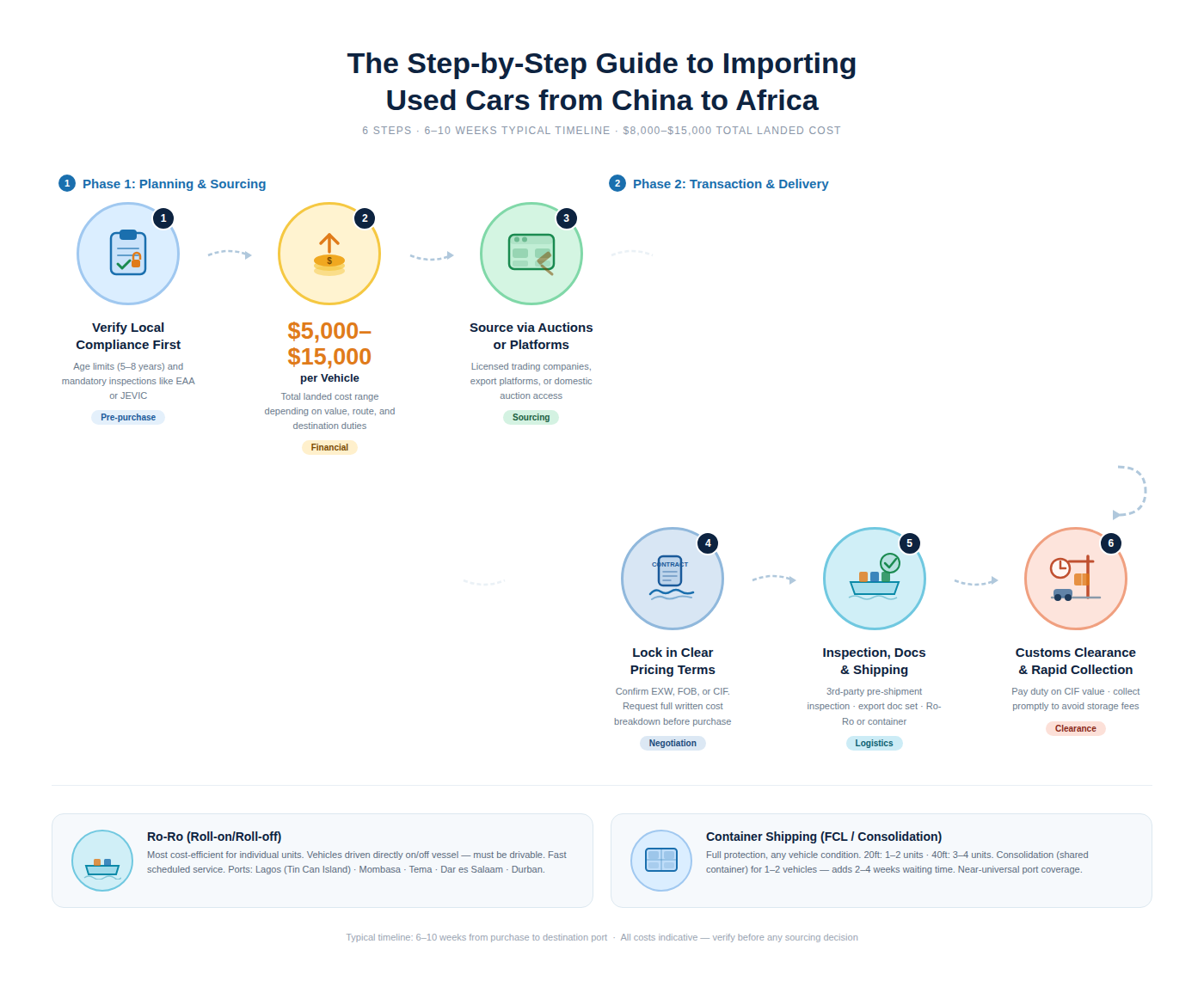
Importing a used car from China to Africa typically costs between $5,000 and $15,000, depending on the vehicle, shipping method, and destination country. This guide explains how to import used cars from China to Africa, covering the full process from sourcing and shipping to customs rules across key African markets, including Nigeria, Ghana, and Kenya. Whether you are importing for the first time or optimizing an existing sourcing strategy, understanding how each step affects cost, compliance, and resale potential is critical.
Why import from China?
Africa is one of the most import-dependent vehicle markets in the world. According to a 2024 report by the United Nations Environment Programme (UNEP), Africa remains one of the largest destination regions for used vehicle imports, based on trade data covering 2015 to 2022. In many countries across the continent, used vehicles are not an alternative to new cars. They are simply how most people buy a car. For decades, this demand was met almost exclusively by exporters from Japan and Europe. That landscape is now shifting. China's domestic automotive market generates millions of used vehicles each year, including hybrids and electric models that barely existed in the used car trade a decade ago. For African dealers, that means genuine choice across model types, price points, and vehicle technologies, all sourced from one of the most competitive supply environments in the world.
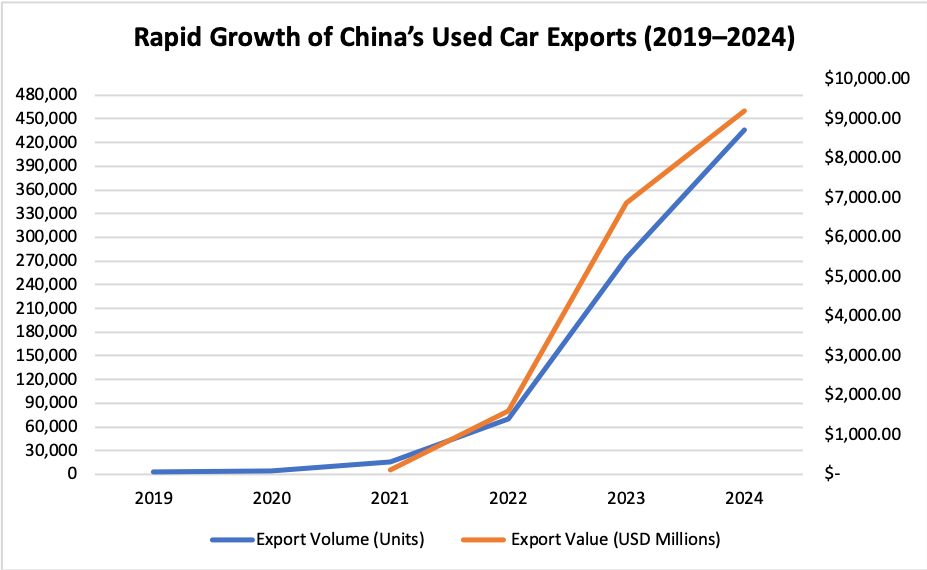
While China only began piloting used car exports in 2019, its expansion has been rapid. Data cited by the China Automobile Dealers Association (CADA), based on official China Customs export statistics, shows that used vehicle exports rose from roughly 4,300 units in 2020 to over 436,000 units by 2024, reaching more than 160 countries.
The momentum in Africa is particularly striking. Recent figures released by the China Passenger Car Association (CPCA) indicate that vehicle exports to Africa reached 222,000 units in the first five months of 2025, up 67% year on year, according to data published by CPCA Secretary-General Cui Dongshu.
For African dealers, this represents a powerful alternative to traditional markets. China’s vast domestic vehicle pool translates to deeper inventory, a broader range of models, and highly competitive pricing. For those who have long relied on a single source country, China represents a market opportunity that is simply too significant to overlook.
Not sure if China fits your market?
Step-by-Step Process to Import Used Cars from China
Importing used cars from China to Africa follows a relatively standard process, but each step requires careful attention to avoid unexpected costs or delays. Understanding this workflow helps dealers and buyers navigate sourcing, shipping, and customs more efficiently. Below is a simplified step-by-step overview of how the process works.
Step 1: Check Import Rules in Your Destination Country
Before selecting a vehicle, you should first check the car import regulations in your destination country. Rules vary widely across African markets and may include vehicle age limits (typically 5–8 years), mandatory pre-shipment inspections (such as EAA or JEVIC), and different duty structures. For dealers, this step is critical, as non-compliant vehicles can lead to unexpected costs, delays, or failed clearance.
Step 2: Estimate Total Import Cost and Profit Potential
Next, estimate the total cost of importing the vehicle to assess whether the deal makes financial sense. The main cost components include the vehicle purchase price, export handling fees, international freight, marine insurance, destination port charges, and applicable import duties.
In practice, most dealers begin with a rough landed cost estimate rather than a detailed calculation. This allows them to quickly filter out vehicles that may not be competitive in their local market.
As a general reference, total costs for a single used vehicle often fall in the range of $5,000 to $15,000, depending on sourcing conditions and destination market factors. The actual figure varies depending on factors such as the vehicle’s value, shipping method, route, and destination country. The cost structure is explained in more detail in the following section.
Step 3: Identify Reliable Suppliers or Available Inventory
Once you have defined your budget and target vehicle criteria, the next step is to identify where to source vehicles. In practice, many buyers begin by exploring available inventory rather than selecting a supplier first, as availability and pricing often drive sourcing decisions.
Vehicles can typically be sourced through export platforms, licensed trading companies, or access to domestic auction markets. These channels differ in terms of inventory availability, pricing transparency, and how much information is provided about vehicle condition. For example, auction access may offer a wider selection and lower prices, while export platforms often provide more structured listings and export support. For dealers comparing both options before committing to a sourcing channel, this guide to sealed-bid vs live auction rules explains exactly how each format works, what the deposit requirements are, and where the pricing differences lie.
At this stage, the focus should be on identifying vehicles that match your target models, year range, and condition requirements. Since inventory in China moves quickly, having a clear sourcing brief and monitoring listings across multiple channels can help you secure suitable vehicles more efficiently.
Step 4: Select the Vehicle and Confirm Pricing Details
Selecting the vehicle involves narrowing down from shortlisted options to a specific unit based on model, production year, mileage, condition, and expected resale demand in the destination market. Pricing terms must be clearly defined before any agreement is reached. Confirm whether the quoted price is based on EXW, FOB, or CIF, as this determines which costs are included and where responsibility transfers during the transaction. Without this clarification, comparing prices across suppliers can be misleading.
The quoted price should not be treated as the final purchase cost. Export handling fees, platform transaction fees, and other charges may be excluded from the initial quotation. Requesting a written breakdown of all cost components ensures transparency and reduces the risk of unexpected price increases before shipment.
Step 5: Arrange Inspection, Documentation, and Shipping
Commission a third-party pre-shipment inspection before the vehicle is released for export. This step produces a condition report that verifies the unit matches the agreed specification and supports customs clearance at the destination port.
Prepare the full export document set in parallel: original vehicle title, export certificate, commercial invoice, packing list, and bill of lading. Requirements vary by destination market, so confirm the exact checklist with your freight forwarder before the shipment is booked.
For shipping, choose between Roll-on/Roll-off (Ro-Ro) and container shipping based on volume and cargo protection requirements. Ro-Ro is more cost-efficient for individual units; container shipping becomes more economical when consolidating multiple vehicles in a single booking.
Step 6: Finalizing Customs Clearance and Port Logistics
On arrival at the destination port, your clearing agent submits the full document set to customs, typically including the bill of lading, commercial invoice, import declaration, and proof of ownership. Any discrepancies in documentation at this stage will delay release and may trigger additional inspections.
Duty payment is calculated on the CIF value of the vehicle and must be settled in full before the unit is released. Rates vary by country and vehicle category, so a pre-calculated duty estimate should already be in place from Step 2.
Once duties are cleared and documentation is verified, coordinate port collection promptly. Storage fees at African ports accumulate quickly, and delays at this stage are one of the most avoidable costs in the entire import process.
How Much Does It Cost to Import Used Cars from China to Africa?
For most single-vehicle imports from China to Africa, total landed cost runs between $8,000 and $15,000. The spread comes down to three things: where the vehicle is going, how it is shipped, and what it is worth on paper, because all three directly affect what you pay at the border.
The core cost components are vehicle purchase price, export handling fee, international freight, import duties, and destination port and clearance charges. Where dealers most often get caught out is on the costs that do not appear in the supplier quote: pre-shipment inspection fees, port storage, and VAT on the CIF value. These are not edge cases. They apply to virtually every shipment and need to be in your numbers before you commit to a purchase.
The table below holds the vehicle and origin port constant to show what destination market alone does to the bottom line.
| Cost Component | Shanghai to Lagos (Nigeria) | Shanghai to Mombasa (Kenya) | Shanghai to Tema (Ghana) |
|---|---|---|---|
| Vehicle purchase price | $6,000 | $6,000 | $6,000 |
| Export handling fee | $200–$350 | $200–$350 | $200–$350 |
| International freight (RoRo) | $1,200–$1,600 | $900–$1,200 | $1,000–$1,400 |
| Pre-shipment inspection | $150–$250 | $150–$250 | $150–$250 |
| Import duty and levies | $3,800–$4,800 | $1,400–$1,800 | $1,200–$1,800 |
| VAT | $600–$800 | $1,200–$1,600 | $900–$1,200 |
| Port and clearance charges | $500–$800 | $350–$550 | $400–$650 |
| Estimated landed cost | $12,450–$14,600 | $10,200–$11,750 | $9,850–$11,650 |
One key takeaway from the table is that the vehicle purchase price is not just a procurement figure. It determines the CIF value, which forms the basis for most import tax calculations across African markets.
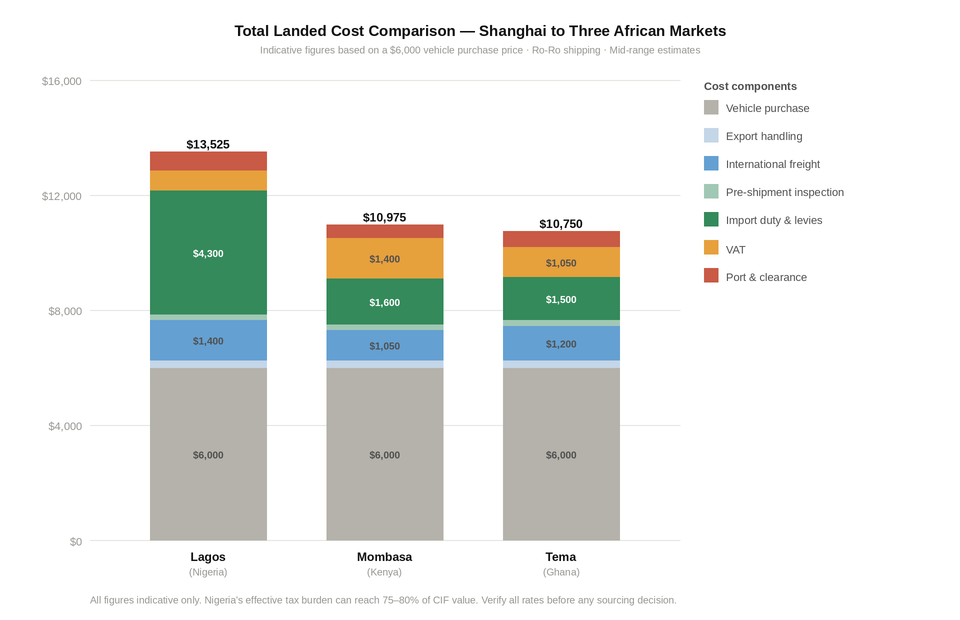
Figures are indicative only. Nigeria's effective tax burden on used vehicles can reach 75–80% of CIF value under current NCS rates. Kenya's import duty was revised to 25% effective July 2025. All figures should be verified against current official rates before any sourcing decision is made.
This creates a compounding effect on the total landed cost, where a higher vehicle price not only increases the upfront cost but also amplifies the associated tax exposure. As a result, a lower purchase price does not necessarily lead to a lower landed cost, especially in markets where duties and VAT are calculated on CIF value.
For dealers managing multiple units, this directly affects how vehicles should be selected before purchase, as even small differences in declared value can lead to significantly different tax outcomes.
Not sure which vehicles minimize tax exposure in your market?
>>> Explore cost-efficient vehicles for your market
Shipping Options for Importing Used Cars from China to Africa
Two shipping methods account for the vast majority of used vehicle exports from China to Africa: Roll-on/Roll-off (Ro-Ro) and container shipping. Choosing between them is not purely a cost decision. It depends on shipment volume, vehicle value, destination port infrastructure, and how much cargo protection the dealer requires.
How Ro-Ro Shipping Works
With Ro-Ro, vehicles are driven directly onto a purpose-built vessel via ramps and secured on deck for the voyage. No container is required. At the destination port, vehicles are driven off in the same way. The process is straightforward, port turnaround is fast, and because loading does not require container stuffing, handling costs at origin are lower.
Ro-Ro is the most cost-efficient option for high-volume shipments of standard passenger vehicles. It works best when the destination port operates a dedicated Ro-Ro terminal. Major African ports with established Ro-Ro facilities include Lagos (Tin Can Island), Mombasa, Tema, Dar es Salaam, and Durban. One practical constraint: vehicles must be in running condition to be driven on and off the vessel.
How Container Shipping Works
Container shipping loads vehicles into a standard 20ft or 40ft steel container for the sea voyage. A 20ft container typically holds one to two vehicles, while a 40ft container can accommodate three to four standard-sized units depending on vehicle dimensions and loading configuration. Larger SUVs reduce the number of units per container.
The key advantage is protection. Vehicles are fully enclosed throughout transit, which reduces the risk of weather exposure or minor damage during the voyage. Container shipping also gives dealers access to a wider range of destination ports, including those without Ro-Ro infrastructure.
For dealers who are not moving enough volume to justify a full container, consolidation is the standard solution. Under a consolidation arrangement, multiple vehicles from different shippers are loaded into a shared container, with freight costs split across units. This brings the per-vehicle cost closer to Ro-Ro rates while retaining the security benefits of container shipping. Consolidation is widely used among smaller and mid-size dealers sourcing from China.
Choosing the Right Method for Your Shipment
| Factor | Ro-Ro | Full Container (FCL) | Shared Container (Consolidation) |
|---|---|---|---|
| Best for | High-volume, standard vehicles | Medium to large orders, higher-value vehicles | Small to mid-size orders |
| Cost per unit | Lowest | Lower at full capacity, higher if underfilled | Moderate |
| Cargo protection | Moderate | High | High |
| Port coverage | Limited to ports with Ro-Ro terminals | Near-universal | Near-universal |
| Vehicle condition | Must be drivable | Any condition | Any condition |
| Lead time | Fast and scheduled | Moderate, depends on container availability and booking schedule | Longer due to consolidation |
| Best choice when | You ship multiple low-cost vehicles and want lowest cost | You can fill a container or need full control | You ship 1–2 vehicles and want to reduce cost |
Ro-Ro is often perceived as the lowest-cost option, but this advantage does not apply equally across all routes. On lanes with limited Ro-Ro vessel frequency or additional port surcharges, the per-unit cost gap between Ro-Ro and a fully loaded container can narrow significantly. In some cases, container shipping becomes equally competitive. For shipments to ports outside the main Ro-Ro corridors, it is more reliable to request a lane-specific freight quote rather than assuming Ro-Ro will always be cheaper.
One factor dealers consistently underestimate is consolidation lead time. A shared container does not depart until sufficient cargo volume is reached, which typically adds two to four weeks before shipment. For dealers managing inventory turnover or fulfilling time-sensitive orders, this delay directly impacts cash flow and stock availability. Factoring consolidation time into the sourcing schedule from the outset helps avoid unnecessary pressure later in the process.
If you are unsure which shipping method fits your next order, requesting a quote based on your vehicle type, shipment volume, and destination port allows you to compare total landed cost more accurately before committing to a booking.
Import Duties When Importing Used Cars from China to Africa
Import duty is one of the most consequential variables in the landed cost calculation, and one of the most frequently underestimated. The rate structure, valuation methodology, and compliance requirements vary significantly across African markets, which means the same vehicle sourced from China can produce very different landed costs depending on where it clears customs. The three sections below cover the current duty framework for Nigeria, Kenya, and Ghana, the three largest destination markets for Chinese used vehicle exports on the continent.
Car Import Duties in Nigeria
Nigeria applies a layered duty structure to imported used vehicles. Under the current framework, importers face a 20% import duty, a 15% NAC levy, and 7.5% VAT calculated on the duty-inclusive value, plus a 4% FOB-based charge introduced in 2026 under the NCS Act 2023. In practice, the combined statutory burden typically lands between 40% and 45% of CIF value, before port and agent fees.
A key consideration for importers is that duty is not calculated solely based on the invoice price. The Nigeria Customs Service may assign a reference market value to each vehicle using internal valuation systems based on factors such as year, make, model, and VIN. Insurance and freight are then added to determine the CIF value used for duty assessment. This means that under-invoicing does not reduce tax liability and may expose importers to compliance risks.
Nigeria's official import prohibition lists used vehicles older than 12 years from the year of manufacture. as set out in the NCS Import Prohibition List. For 2026 shipments, that means model year 2014 or newer. Note that port-level enforcement has at times applied a stricter threshold in practice — dealers are advised to verify current clearance conditions before committing to stock older than 2015.
Car Import Duties in Ghana
For Ghanaian dealers importing used cars from China, the key issue is not simply the headline duty rate, but how Ghana Customs determines the value of the vehicle and how that valuation drives the entire tax stack. Under the current framework outlined by the Ghana Revenue Authority, passenger vehicles are typically subject to import duty rates of 5%, 10%, or 20%, depending primarily on engine size and fuel type. However, duty is only one component of the total landed cost.
Beyond import duty, dealers must account for multiple additional charges. These include VAT at 15%, the National Health Insurance Levy (2.5%), and the GETFund Levy (2.5%), which are applied on a duty-inclusive taxable value, forming an effective consumption tax layer of approximately 20%. Additional statutory charges include the ECOWAS Levy (0.5%), AU Levy (0.2%), as well as other applicable fees and processing costs at clearance. Because these taxes are calculated on a value that already includes import duty, the total tax burden compounds quickly as the customs value increases.
This is why the central tax question in Ghana is not “Which duty band does this vehicle fall into?” but rather “What value will Customs assign to this vehicle at clearance?” In practice, Ghana’s ICUMS customs system applies reference pricing mechanisms based on vehicle specifications, which can result in a taxable value above the declared transaction price. This means that a lower purchase price in China does not necessarily translate into a lower landed cost if the customs benchmark value is higher.
As a result, effective sourcing strategy in Ghana is driven less by price negotiation and more by vehicle selection. Dealers who consistently manage margins tend to prioritize left-hand-drive vehicles, relatively recent model years, and moderate engine sizes, as detailed in this guide to Ghana used car import requirements and sourcing rules. Larger engines increase duty exposure, while older vehicles face higher cost pressure and regulatory uncertainty. Although older imports are not strictly prohibited, vehicles above 10 years generally carry higher commercial risk, making sub-10-year stock a more stable choice. In this context, China’s advantage lies not in preferential tax treatment, but in the depth and flexibility of its used vehicle inventory, which allows dealers to select vehicles that better fit Ghana’s tax structure, compliance environment, and resale dynamics.
Car Import Duties in Kenya
Kenya applies a multi-layered tax structure to imported used vehicles. Under the framework of the East African Community Common External Tariff, import duty is applied at 25% of CIF value. Additional charges include an Import Declaration Fee (3.5% of CIF, subject to a minimum fee), a Railway Development Levy (2% of CIF), excise duty calculated on the CRSP-derived value and varying based on engine capacity and fuel type, and VAT at 16%.
Unlike simpler tax systems, VAT in Kenya is applied on a cumulative taxable base that includes CIF value, import duty, excise duty, IDF, and RDL. As a result, total tax exposure compounds significantly as the assessed customs value increases.
For customs valuation, Kenya applies a Current Retail Selling Price (CRSP)-based framework. The Kenya Revenue Authority maintains a reference pricing database and determines vehicle value using predefined retail benchmarks adjusted for depreciation. In practice, this means that landed cost calculations should be based on expected CRSP-derived values rather than the transaction price alone.
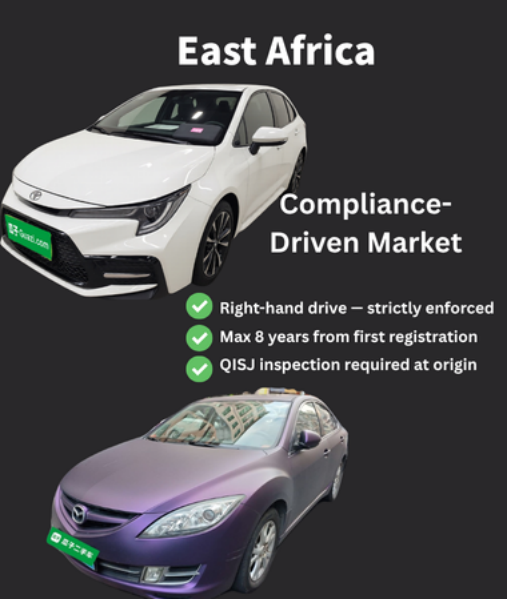
Kenya enforces a strict 8-year age limit from the year of first registration, as outlined by the Kenya Revenue Authority, and requires right-hand drive (RHD) configuration. These requirements narrow the eligible vehicle pool when sourcing from China, where domestic inventory is predominantly left-hand drive. Dealers targeting the Kenyan market should filter specifically for RHD-compatible stock and recent model years at the sourcing stage.
On inspection, all used vehicles exported to Kenya require a Pre-Export Verification of Conformity (PVoC) certificate issued by a KEBS-appointed inspection body before shipment. This process can be completed in China through locally authorized inspection agents prior to export. Vehicles shipped without a valid certificate face significant clearance risks, including delays, penalties, or rejection at the port of entry. Securing PVoC certification prior to shipment is a critical requirement that should be built into sourcing and logistics planning.
How These Markets Differ in Practice for China-Sourced Vehicle Imports:
| Dimension | Nigeria | Kenya | Ghana |
|---|---|---|---|
| Primary source of cost uncertainty | Customs valuation variability (benchmark-driven) | Compliance constraints (age, RHD, inspection) | Valuation + engine-size sensitivity |
| Pricing predictability | Low (valuation-driven) | Medium (reference-based CRSP) | Medium (structured but variable) |
| Reliance on invoice price | Minimal | Limited (CRSP-based) | Limited (adjusted against benchmark values) |
| Sourcing difficulty (China) | Medium (valuation + age band considerations) | High (RHD + age limit) | Low |
| Inventory flexibility | High | Restricted | High |
| Where most dealers lose money | Underestimating customs valuation | Ignoring compliance filters before purchase | Misjudging engine impact and assessed value |
| Margin control approach | Pre-check valuation scenarios before purchase | Strict rule-based filtering before sourcing | Optimize vehicle specs before purchase |
| Best fit for sourcing strategy | Opportunistic buying with valuation awareness | Rule-based filtering before purchase | Selective optimization of vehicle profiles |
Best Used Cars to Import from China to Africa
Africa is not a single used car market. Vehicle demand in West Africa, East Africa, and North Africa is shaped by different road conditions, import regulations, fuel infrastructure, and resale dynamics. What sells consistently across these markets is not determined by consumer preference alone, but by what works within each market's constraints. For dealers sourcing from China, understanding these constraints is what determines whether a vehicle moves quickly or sits on the lot.
Sedans Popular in African Markets
Compact and mid-size sedans represent the largest segment of used vehicle demand across urban African markets. Their appeal comes down to transaction efficiency: lower import cost and tax exposure, strong resale liquidity, and a widely established maintenance and parts ecosystem that keeps running costs predictable for end buyers.
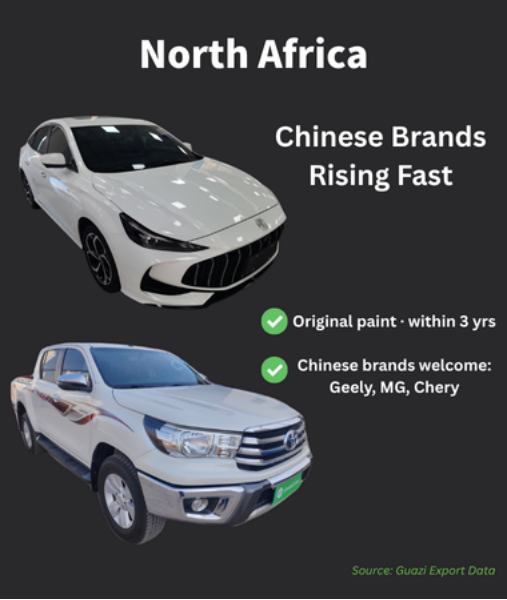
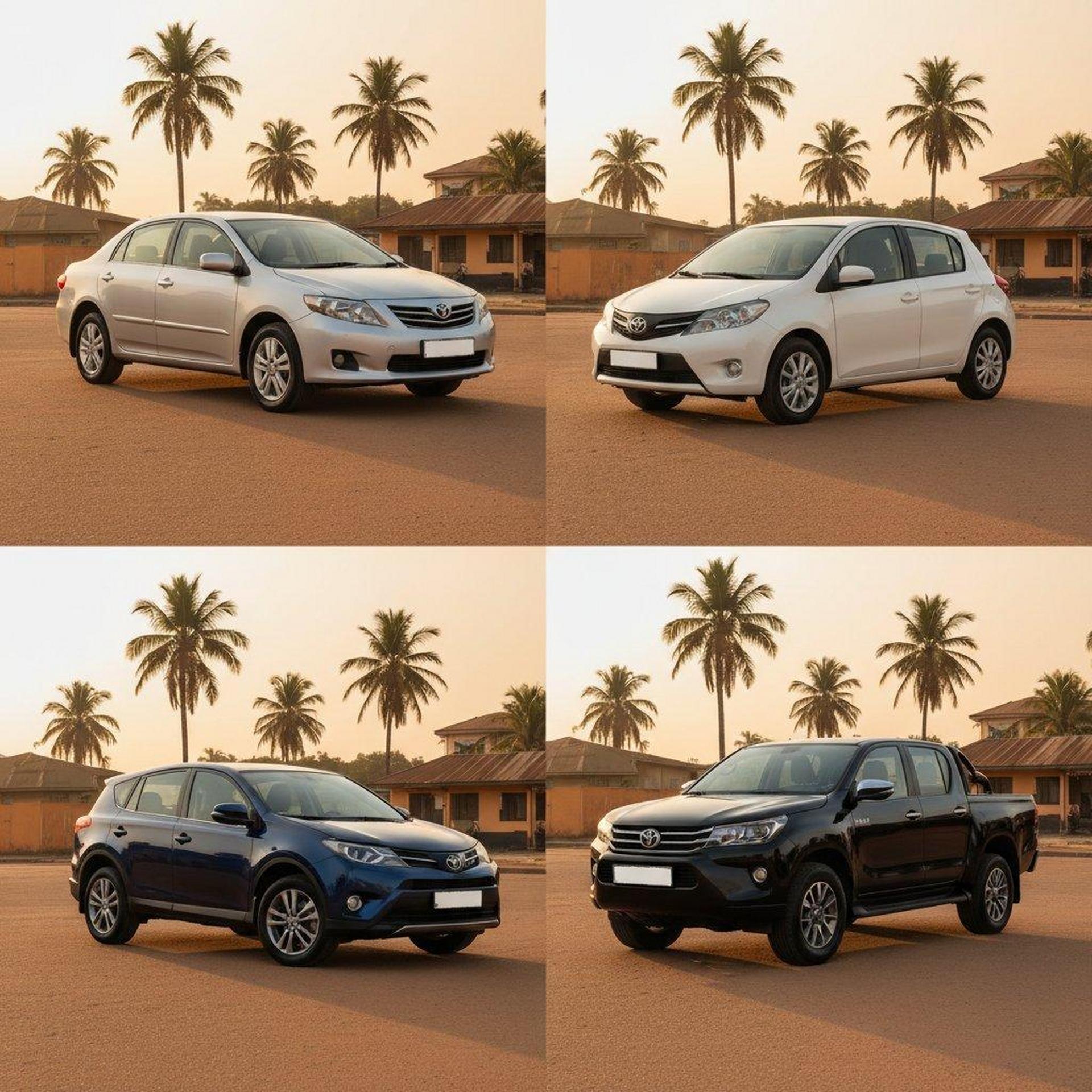
Toyota Corolla and Camry dominate the mass segment across West and North Africa, with consistent demand driven by reliability reputation and parts availability. In North Africa specifically, where vehicle age limits are among the strictest on the continent, demand is concentrated in newer model years, typically 2021 onwards, with buyers showing strong preference for original paint and documented service history.
China's used vehicle supply is particularly well suited to this segment. The domestic Chinese market generates a large and continuous volume of compact and mid-size sedans across multiple age bands, including globally recognized models that African buyers already know. Left-hand drive configuration across virtually all Chinese domestic inventory aligns naturally with the majority of African markets, removing one of the sourcing constraints that limits supply from other origins.
SUVs and Crossovers
SUV demand in Africa is driven less by lifestyle preference and more by adaptability. Variable road conditions, combined with the need for vehicles that serve multiple purposes across family and commercial use, make compact and mid-size SUVs a structurally reliable segment in most African markets. In higher-value urban segments across Nigeria and Kenya, SUVs also carry strong perceived value that supports resale pricing. For Nigerian dealers weighing up the options, this comparison of SUV vs sedan for Lagos traffic breaks down the real cost differences on the ground.
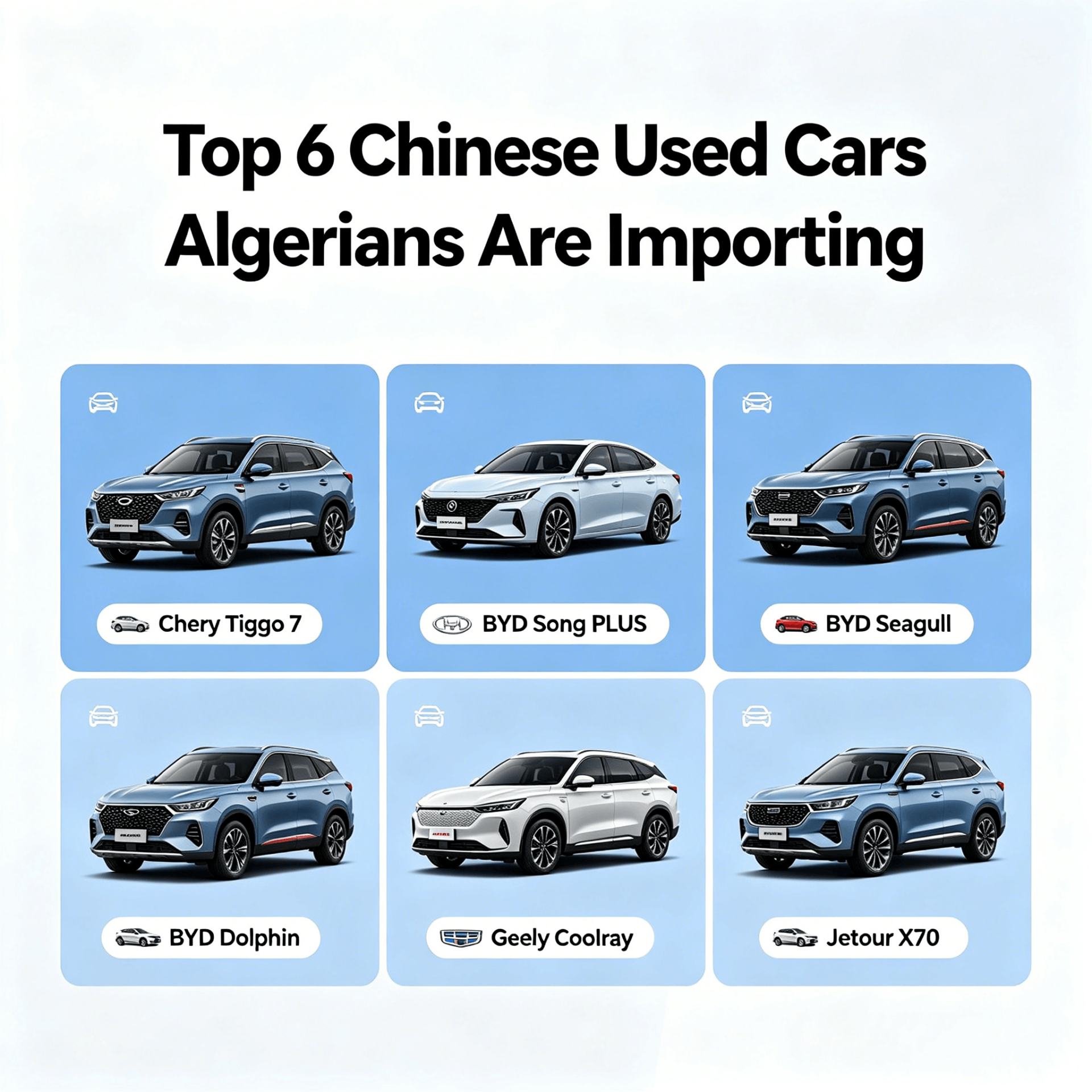
Demand is concentrated in models with established reputations for durability and low maintenance cost. Compact SUVs with broad parts availability perform consistently across West and East Africa, while Chinese brands have gained meaningful visibility particularly in North and West Africa, where competitive pricing and improving brand recognition have begun to shift buyer behavior among cost-conscious dealers and their customers.
China offers broad supply across both Japanese-Korean and Chinese-brand SUVs. Models that remain in high demand across Africa are available in significant volumes in the Chinese secondary market, alongside a growing inventory of Chinese-brand SUVs at more competitive price points. The diversity of available stock allows dealers to source across multiple price bands from a single market, which is a structural advantage that few other supply origins can consistently match.
Pickup Trucks and Utility Vehicles
Pickup trucks occupy a distinct position in African vehicle markets. In many West African markets, a pickup is not a lifestyle purchase. It is an income-generating asset used for transport, agriculture, construction logistics, and small commercial operations. The light commercial vehicle segment across Sub-Saharan Africa is estimated at approximately $15 billion, according to industry research, with demand concentrated in Nigeria, Kenya, and South Africa across transport, last-mile delivery, and agricultural applications. This makes pickups one of the most demand-stable categories for dealers, with buyers purchasing on commercial logic rather than personal preference.
In South Africa, the most mature automotive market on the continent, the Toyota Hilux recorded over 36,000 units sold in 2025, according to Naamsa. While South Africa differs structurally from many other African markets, this performance reflects a broader pattern of strong and consistent pickup truck demand across the continent, particularly in segments driven by commercial use rather than consumer preference.
Chinese pickup trucks are increasingly present in this segment, particularly in cost-sensitive markets where the price differential relative to Japanese alternatives justifies some trade-off in brand familiarity. For dealers sourcing from China, pickups represent a category where Chinese domestic supply offers genuine price advantages, and where demand from end buyers is driven by utility rather than brand, making market entry more accessible than in brand-sensitive segments.

>>> Get sourcing recommendations for importing cars from China to Africa
What Can Go Wrong When Importing from China?
Importing used vehicles from China involves operational risks, as with any international sourcing process. These risks are not unique to China, and more importantly, they are well understood and can be effectively managed with the right sourcing structure. For dealers entering this supply route, the key is not to avoid risk entirely, but to control it through verification, inspection, and documentation discipline.
Supplier Verification and Transaction Risk
The most common issues in early-stage sourcing arise not from the market itself, but from working with unverified suppliers. These include cases where sellers misrepresent available inventory, lack proper export qualifications, or operate through informal trading structures without a verifiable transaction history.
In practice, these risks are largely avoidable. Reliable sourcing begins with supplier verification through formal business registration, confirmed export capability, and a documented track record of completed transactions. Working through established export platforms or directly with experienced exporters significantly reduces exposure compared to informal outreach channels.
Vehicle Condition and Inspection Control
Differences between listed vehicle condition and actual condition at shipment are a known risk in any used vehicle market. This can include undisclosed accident history, prior structural repairs, cosmetic reconditioning, or mechanical issues that are not visible through photos alone.
Professional buyers treat this not as an exception, but as a standard control point. A third-party pre-shipment inspection conducted before the vehicle leaves China is a routine step in structured sourcing. A proper inspection report should cover body condition, structural integrity, mechanical systems, and odometer consistency. Relying solely on seller-provided information is not considered sufficient in professional transactions.
Documentation Accuracy and Clearance Risk
Customs clearance in destination markets depends entirely on the accuracy and completeness of documentation. Errors such as mismatched VINs, incorrect vehicle descriptions, missing certificates, or improperly issued export documents can lead to delays, additional inspection costs, or refusal of entry.
Among all risk factors, documentation control is one of the most critical. These issues are typically preventable when requirements are confirmed in advance. Dealers should verify document requirements with their clearing agent in the destination country before shipment is arranged, and ensure that suppliers can provide all required documents in the correct format. Requirements vary significantly across African markets, and assumptions based on previous shipments to different countries are a common source of error.
Inventory Availability and Export Readiness
Another operational challenge specific to the Chinese market is the gap that can exist between listed inventory and actual export-ready vehicles. Due to high inventory turnover and multi-channel listings, a vehicle shown as available may no longer be in stock, or may not meet export documentation requirements.
This is not a structural limitation, but a process consideration. Experienced importers confirm real-time availability and export readiness before committing to purchase. This includes verifying that the vehicle is physically in stock, that ownership and documentation are clear, and that it can be legally exported under current regulations.
How to Reduce Import Risk Before You Buy?
These risks are not exceptional cases, but standard considerations in cross-border used vehicle trade. As a result, the controls used to manage them are also standard operating practices among experienced importers. Work with suppliers who can demonstrate verifiable export credentials and a clear transaction history. Treat third-party inspection as a mandatory step for every vehicle, not just high-value units. Confirm all documentation requirements with your destination clearing agent before finalizing the purchase. Structure payments in a way that retains leverage until inspection and documentation milestones are completed. And consider any supplier who discourages independent verification as a significant red flag, regardless of pricing.
In practice, these issues are not what determine whether a shipment succeeds or fails. What matters is whether they are identified early and handled properly before the vehicle leaves the port. For dealers who approach sourcing this way, importing from China becomes less about risk, and more about making informed decisions at each step.
All policy data and duty rates referenced in this guide reflect information available as of March 2026. Rates and regulations are subject to change; readers are advised to verify current requirements with a licensed customs agent before making sourcing decisions.








About Us
Follow US


Copyright © 2015~2026 https://en.guazi.com/, Chongqing Guazi Enterprise Consulting Service Co., Ltd. All rights reserved.