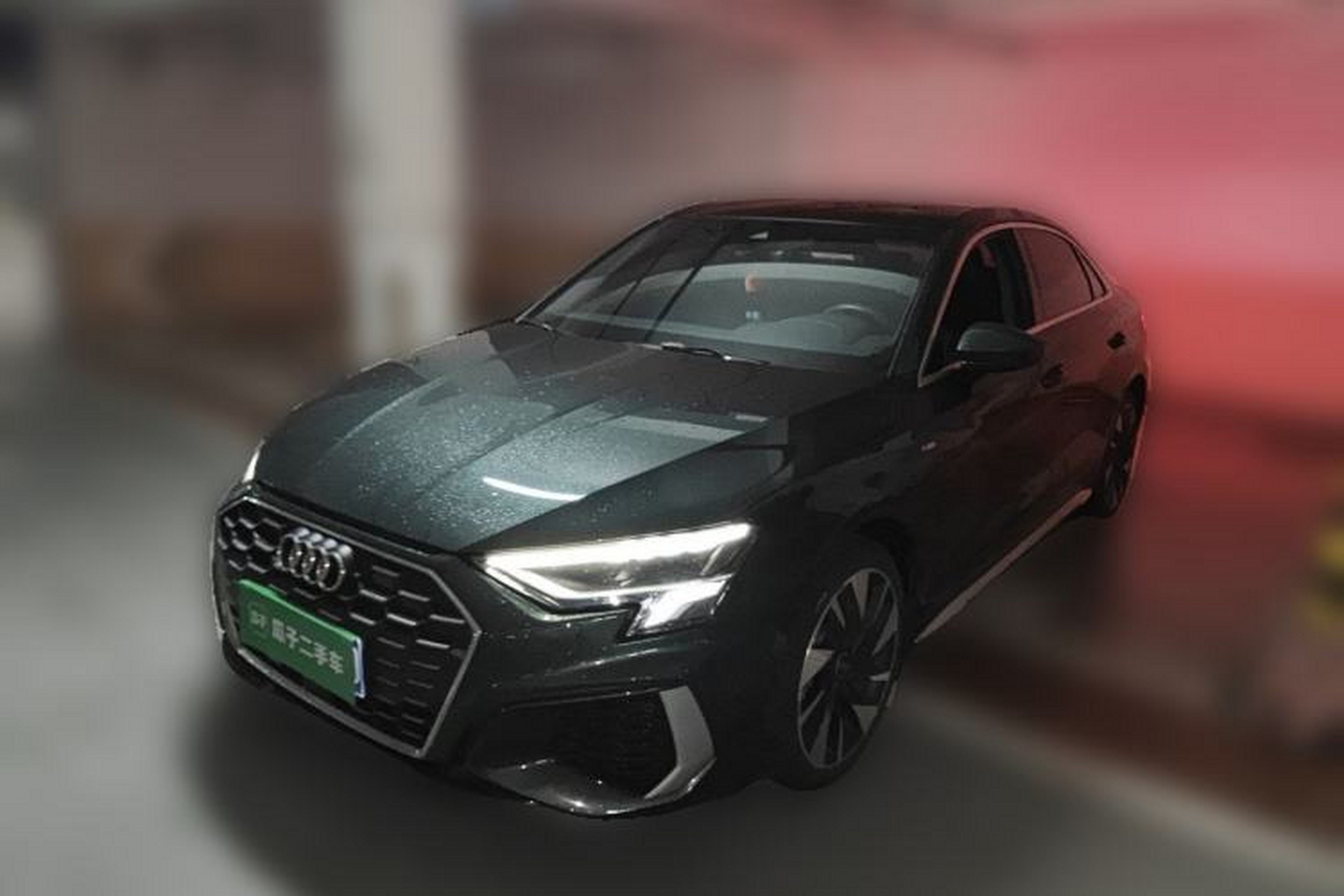


Guazi H1 2026 Report: China’s No. 1 Used-Car Transaction Platform
Guazi’s H1 2026 data report examines used-car trading, NEV growth, nationwide circulation and the shift toward better quality and value in China.
On 23 June 2026, the State Council Information Office held a press conference on “Enlarged car consumption throughout the chain." At that meeting, according to the Ministry of Commerce, from January to May this year, the ratio of new car consumption to second-hand car trade for the first time exceeded 1:1, compared with 0.6 a few years ago. According to the Ministry of Commerce, "the faster the second-hand car flows, the faster the new car will be consumed, the faster the cycle will be formed."
In the current age of stock circulation in the industry, Guazi Used Cars, as the front platform of the used-car circulation industry, aggregates the relevant transaction data for the first half of 2026, thus observing the structural changes that are taking place in the second-hand car market and providing a trend reference for users who sell or buy them.
Selection of over 1.52 million users—Guazi Used Cars trades first in the country
As the industry enters the mature-market era, refined operations replaces extensive development, and the efficiency of the circulation of used vehicles determines the upper limit of size.
According to data published by the China Automobile Dealers Association, the volume of Chinese used‑car transactions in 2025 reached 20.108 million, surpassing the 20 million mark for the first time. Over the past decade, China's used-car market has doubled its growth, while some industry-leading platforms have traded efficiency for larger-scale growth through years of deep tillage and strategic innovation.
A market status statement issued in June 2026 by the Champu Consulting Group, a third‑party research institution, indicated that Guazi Used Cars had been certified as "the country’s first platform for used‑car transactions." This certification is calculated by measuring the actual performance of second-hand car trading enterprises across the country (excluding Hong Kong, China, and Australia) in 2025, by using the number of stations that actually complete the transfer, excluding those that provide only clues, testing, or value-added services that are not.

When the platform has a sufficiently large scale of transactions, the intensification of the supply chain, the abundance of vehicle reserves, and the reach of after-sales services will be upgraded. For consumers, a leading platform implies greater choice and more competitive pricing space. To date, more than 1.52 million users have purchased satisfactory used vehicles on Guazi Used Cars platform.
New energy penetration triples in industry—The share of new energy in Guazi is far greater
New energy used vehicles are undergoing a leap from the margins to the mainstream.
Data released by the China Automobile Dealers Association show that the national rate of second-hand new energy penetration increased from 3.6 per cent at the end of 2022 to 11.6 per cent in April 2026. This means that new energy is no longer just a story of a new car market, which is becoming a real choice for a growing number of consumers in the area of used cars.
This trend is also supported by retail data on Guazi Used Cars. The data show that in the first half of 2026, the average rate of new energy penetration for the whole of Guazi used-car platform began to rise steadily at the beginning of the year and is now about three times higher than the overall market penetration rate. As early as 2025, the second-hand Guazi car also gained the market position of the "new energy second-hand car trade", certified by the Champu Consulting, and this lead advantage was further consolidated in the first half of this year.

The strong rise of new energy used vehicles has also changed the previous preservation rate pattern. The analysis of market data issued by the Secretary-General of the United Nations, Choi Dong-sook, indicated that in May 2026, the average trade price of second-hand fuel vehicles had fallen by 18.7 per cent over the same period, and the average residual value of three-year-old fuel vehicles had fallen by only 38.2 per cent, or 21 percentage points over 2023.
For consumers who had previously feared overpriced new energy sources, the change had given a positive signal that the new energy used vehicles had gradually moved away from the "unreserved" label. In the case of sale or replacement, the choice of appropriate channels, such as the C2C model, for the direct sale of vehicles to the end-buyer would also achieve a significant retention of value and would effectively reduce the discount losses on second-hand vehicles for new energy.
Cross-provincial over-industry ratio—The Guazi made the national price real
Cross-regional movement is a key indicator of the dynamism of the used car market.
According to data from the Chinese Association of Automobile Circulation, in the second quarter of 2026, the national rate of transfer reached 32.3 percent, which means that nearly one-third of used car transactions have broken territorial boundaries. On Guazi's used car platform, the rate of cross-provincial movement is more than twice the national rate of transfer, while it is close to 90 percent across cities. This means that every car on the platform is looking for buyers among 1.4 billion people who truly recognize its value.
On 24 May 2026, the Daily People's Journal also reported that it had confirmed the positive impact of the “personal direct sale” model of Guazi Used Cars and cited a representative and real case in which a Zhongshan owner in Guangdong successfully sold the car to a buyer in Liao Ningyang, 2,800 km away, at a price about 10 percent higher than the traditional channel.
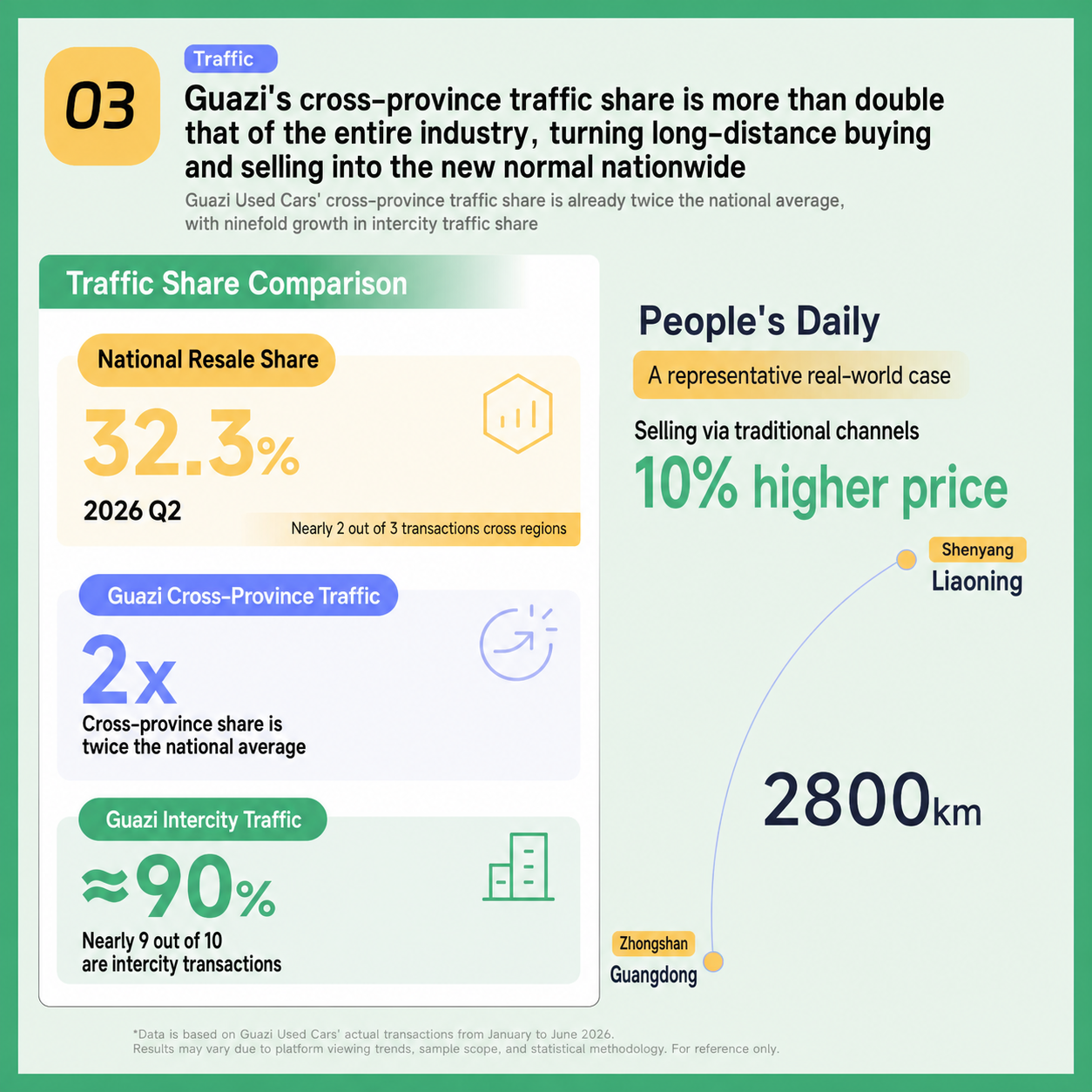
Furthermore, with an integrated national traffic network, Guazi Used Cars is no longer an ‘on‑island’ shop in the traditional sense. Through its nationwide store network and on‑site inspection service, it can reach individual sellers and buyers across the entire country, turning the idea of a national price into a practical bargaining tool that consumers can use on their own initiative.
Guazi market is nearly three times more efficient than the industry—Structural price advantages of the efficiency revolution
For the used-car industry, the speed of inventory turnover is the most visible operational efficiency indicator.
According to data released by the Secretary-General of the United Nations, Choi Dong-sook, in the second quarter of 2026, only 37 percent of the national second-hand vehicle stock structure was available for up to 15 days, 36 percent for more than 30 days, and a polarized “V” structure as a whole. In traditional lower‑tier stores, the inventory cycle is much longer, averaging around 40 days. Every day a vehicle sits in the parking lot adds cost, which is ultimately reflected in the final price and borne by the consumer.

Over more than a decade of operation, the company has built an integrated national network for vehicle circulation and developed a direct‑source capability for individual vehicle distribution. On this foundation, it has also launched the innovative Guazi Hand Yard, which is currently being piloted in select cities.
The Guazi Direct‑Sale Store operates as both a physical and a traditional retail channel. By combining precise AI‑driven pricing with cross‑regional vehicle transfers, the Direct‑Sale Store reduces the average inventory cycle to 15 days—nearly three times faster than the industry average. Faster turnover lowers the cost of holding each vehicle, and lower holding costs create more room for competitive pricing, forming a positive cycle of ‘lower prices, faster sales, lower costs.’ For consumers, a faster‑moving platform means the final vehicle price no longer carries the heavy ‘possession‑cost’ premium.
100% of all people at Guazi store—No layer increase from circulation structure
In the traditional second-hand car circulation chain, a car moves from the hands of its owner, often through multiple layers, such as receivers, wholesalers, retail stores, etc., with an average of 2.5 reversals, each time at a 5 percent cost and eventually higher than 10 percent. Much of the overpayment by consumers does not translate into the value of the vehicle itself but goes to the middle.
The model of a Guazi shop is the structural response to this problem. 100 percent of the Guazi are sold directly for personal vehicles, cutting off all the middle links and eliminating price escalation from the circulation structure.
To ensure a strong price advantage, Guazi also uses AI‑driven algorithms to screen personal listings, selecting about 2 percent of the nearly 10,000 individual second‑hand cars that enter the system each day—roughly two out of every hundred. According to Guazi’s second‑hand car price monitoring, these vehicles fall within the lowest 20 percent price segment of the industry.
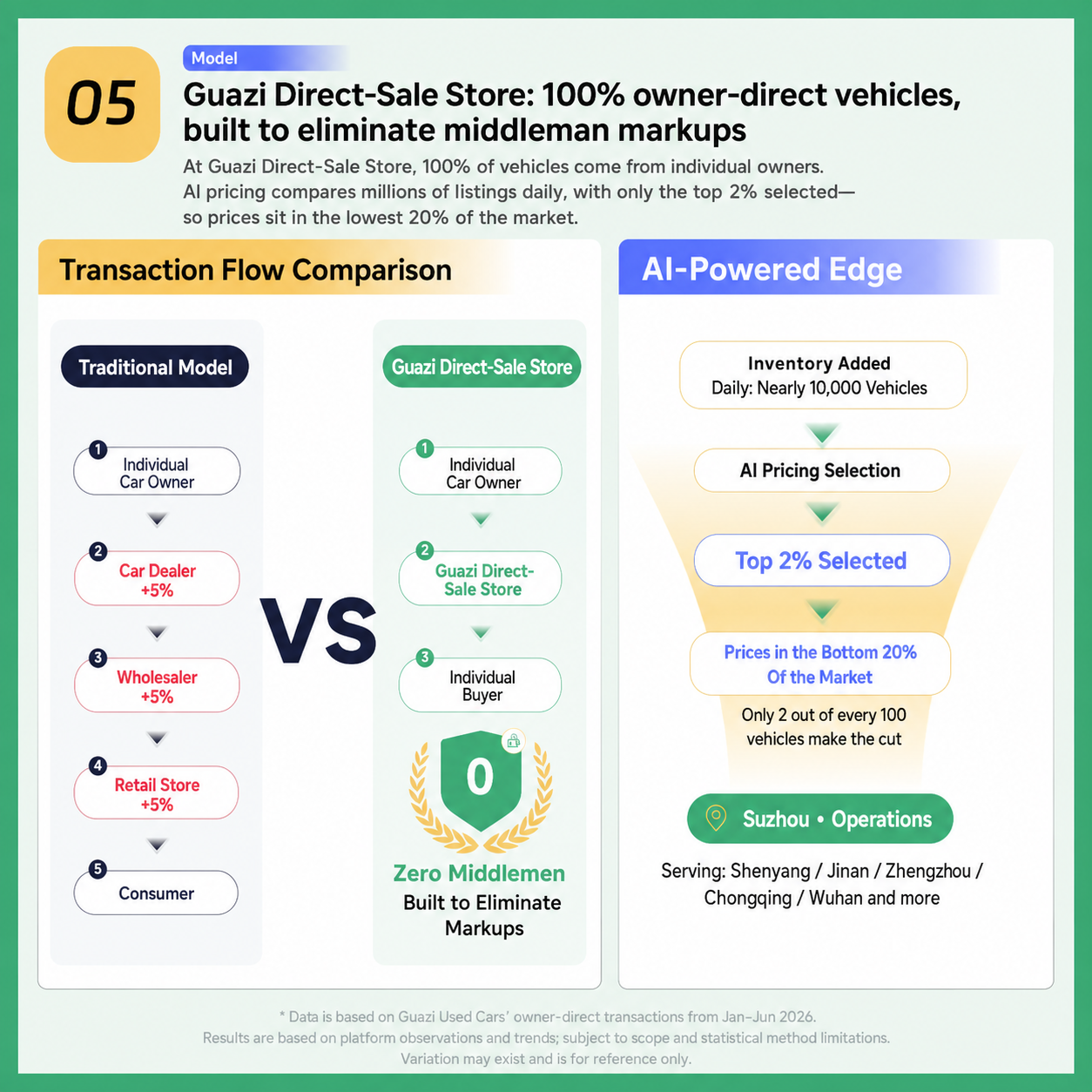
At present, the Suzhou Head Office of the Guangjo Shop is operating on a trial basis, and there are approximately 500 cars in real time alone, with luxury cars, new power areas, and special-priced cars, which are available for one-stop shopping. In addition, the construction of barangays in the cities of Shenyang, Jinan, Zhengzhou, Chongqing, and Wuhan is under way.
The old car sells at a good price—The national demand match for Guazi Direct-Sale Store addresses supply and demand mismatch
The average age of our cars is increasing. According to Ministry of Commerce data, as of June 2026, the proportion of vehicles of more than seven years of age had exceeded 50 percent in the country, and over half of the vehicles on the market were “high-age vehicles."
However, data from the Chinese Association for Car Circulation show that in April 2026, more than 70 percent of the national second-hand car trade was under six years old. A large stock of older vehicles at the macro level, combined with relatively narrow market circulation channels, has led many owners of ‘old’ cars to sell at low prices and, as a result, to suppress their own replacement needs.
This imbalance between supply and demand is corrected on the Guazi Used Cars platform. Through its national network, Guazi has effectively created a cross‑regional C2C demand link, breaking away from the traditional ‘local‑to‑local’ used‑car circulation model. Within the platform’s transaction structure, sub‑new vehicles under three years old, mainstream vehicles between three and six years old, and older vehicles over seven years old are represented in nearly equal proportions.
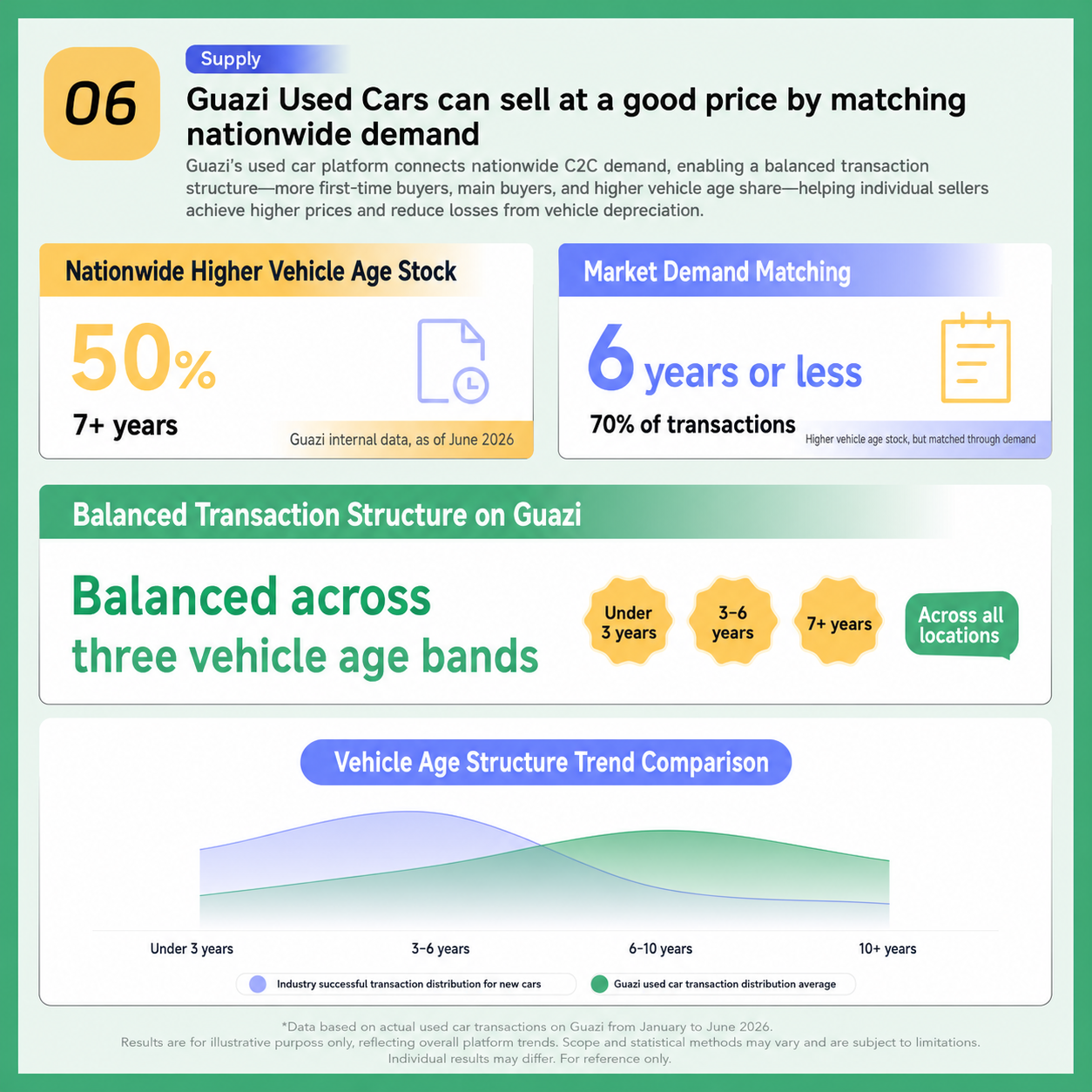
Every car can find a genuine buyer for its value anywhere in the country, free from the limitations of local market preferences. Through Guazi’s personal direct‑sale channel, owners can present their vehicle information directly to potential buyers nationwide, effectively avoiding middle‑layer price losses and allowing older vehicles to sell at a fair and reasonable price.
The second-hand Guazi car has been used to drive consumption upgrades with quality confidence—Buying used cars from Purpose to Specific
The second-hand car market is gradually moving from “price-sensitive” to “value-sensitive”.
According to data from the Chinese Association of Automobile Circulation, half of the country's second-hand car trade is still concentrated in “low-cost areas” below $50,000, and traditional markets still have a “low-cost” conventional perception of second-hand cars. However, data from Guazi used-car platform show a very different picture of consumption—nearly 60 percent of second-hand cars at a stable price standing on 50,000 steps. For the users on the platform, the second-hand car is no longer a “back-to-back” choice, but a quality that coexists with reason and taste.
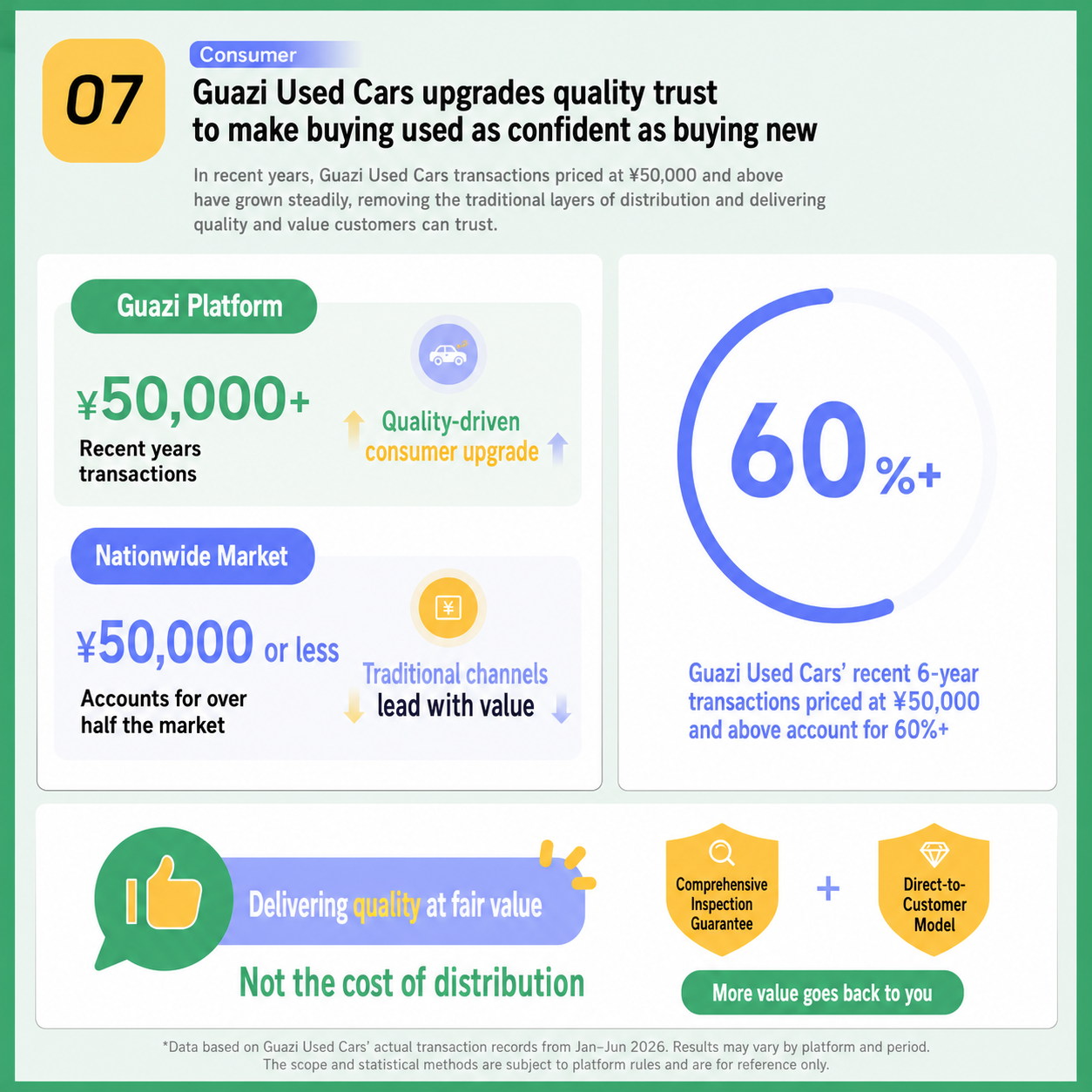
Behind this structural upturn is a solid endorsement of “low-priced, high-quality” used cars. On the one hand, the lack of trust in traditional markets has been fully compensated by rigorous testing and better sales. In addition, through an integrated national network for the circulation of vehicles and the direct extraction capacity of individual sources of vehicles, Guazi has completely cut down the long chain of price increases in the middle layers of the traditional circulation chain, so that every penny is accurately returned to the value of the vehicle itself. The price paid by consumers corresponds to the quality of the solid product rather than to the redundant cost of circulation. On a Guazi used-car platform, the contrast between "cheap" and "good" is being broken — whether it's a line-by-line purchase through a Guazi used-car mall or an online platform that selects the source of a person's car, it can achieve "low-priced" high-quality car purchases.
What's worth buying in the first half of 2026. Classic fuel truck on the base, with an autonomous new energy package covering half the mountain
Buying a car is a big deal, and when consumers do not know where to start, real transactional data tends to be of more reference value than parameter tables. The second-hand Guazi car published a list of car purchases in the first half of 2026, based on real data, which in fact represents the result of the consumer's "money vote."
In the case of fuel trucks, utility vehicles remain the preferred option for the general public. The classic car types of Bok-Eng, the popular, the Japanese, the Ford Fox, the popular Polo, and others are in the top 10 on the list, and the permanent trees of the Haft H6 and Buick GL8 subcategories also maintain a steady trade heat. For first-time purchasers, these models represent the best-negotiable options in the market, the largest holdings, and the lowest maintenance costs for follow-up repairs.
In the area of new energy, the Pentagon Magnum MINI EV has been at the top of the list with a very low car purchase threshold and strong practicality. Tesla Model Y and Model 3 ranked second and third, highlighting brand appeal. It is worth noting that, with the exception of Tesla, the top 10 of the new energy sales were almost entirely autonomous (Biadi, Jiley, Zero Run, Millet, etc.) in the second-hand car market during the first half of the year.
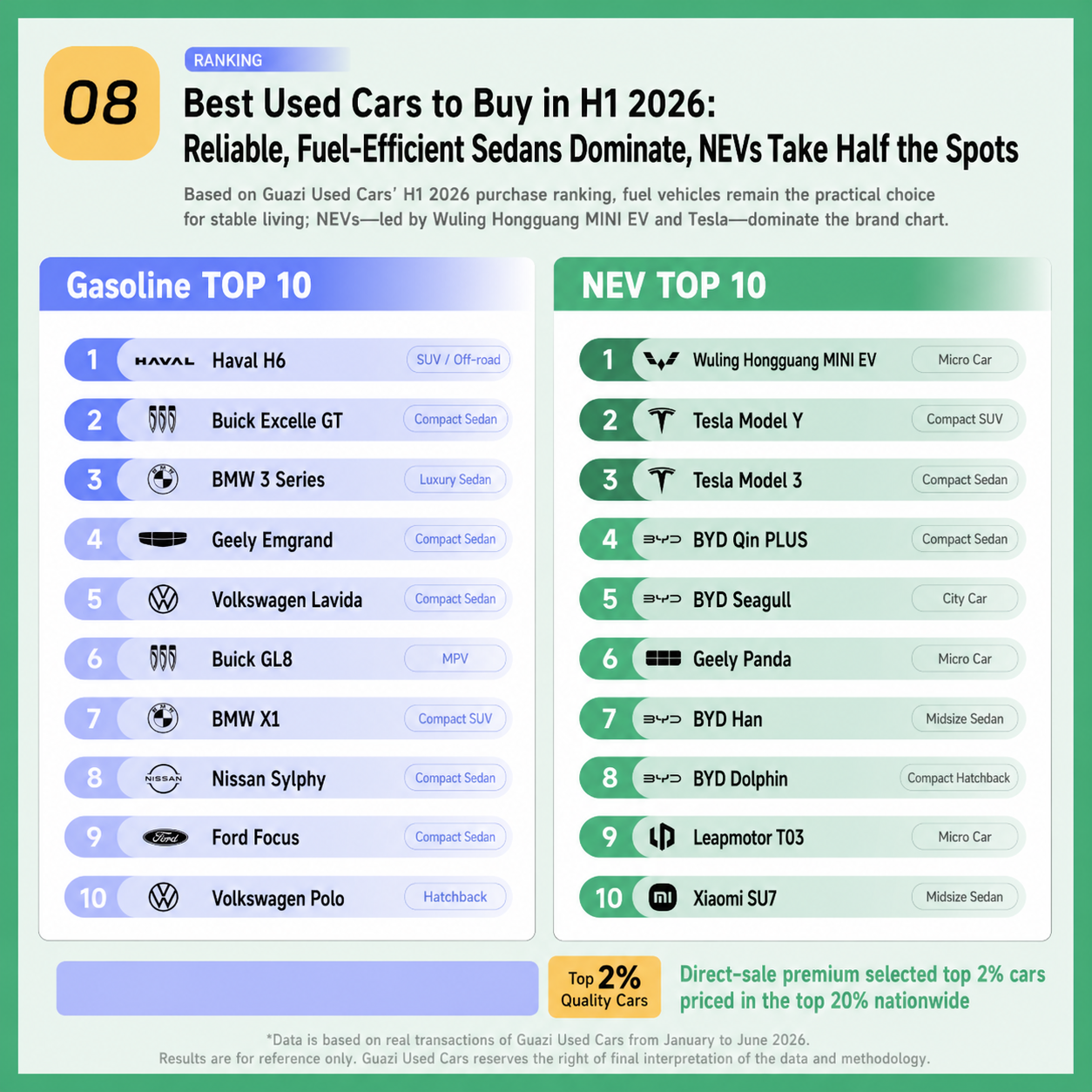
By leveraging Guazi Used Cars’ nationwide network, users can compete in real time with vehicle supply across the country through the online platform, and they can visit offline stores to inspect vehicles in person. The 2 percent of individual vehicles selected for display in these stores have already been screened by AI and big‑data models, and their prices fall within the lowest 20 percent segment of the national market.
What's worth selling in the first half of 2026—classic walker flows, hot new energy supply and demand
The first half of 2026 was also marked by a strong structural characteristic in terms of the end of the car.
In the case of fuel trucks, the traditional popular car model continues to dominate—the hotness of practical car types such as Japanese production, popular access, Toyota Corolla, Beque England, Ford Fox, popular Golf, and Polo. It is a matter of concern that the BMW 3 and BMW 5 models are also on the top 10 lists and are particularly prominent in the operational models.
With regard to new energy sources, the Pentagon Macro MINI EV has been at the top of the car market with a low threshold; Tesla Model 3 and Model Y have continued to circulate in large numbers with their brand appeal; and hot-door models such as Biadehan and Qin PLUS have accumulated significant holdings over the years. The whole new energy market overlaps with the hot-door system of car purchase, with both the hot brand and car type in supply and demand.

Popular car types also face a traditional pain point. Because these vehicles sell easily, dealers often use seemingly justified reasons to push down the purchase price. By linking directly to end‑user demand through a personal direct‑sale model, the buyer’s offer reflects the vehicle’s actual value, leaving no room for deliberate price manipulation and resulting in a naturally fairer transaction. For owners who need to sell, reaching end‑buyers directly through personal distribution channels is often the more desirable choice.
In the first half of 2026, China's second-hand car market was accelerating into the age of stock flows, driven by a policy of exchange for old and new. The balance between new and second-hand car trade, the rapid increase in the penetration of new energy sources, and the continued dynamism of cross-regional flows have shown that circulation efficiency is becoming the core competitiveness of the industry. The second-hand Guazi will continue to use the twin-track model of “line-to-line integration” to spread the retail innovation of “local experience + national vehicle source” and to continue to promote greater efficiency in the circulation of second-hand vehicles so that more users can enjoy the experience of “selling personal cars and buying them more cheaply."