

World Cup Special • Save up to $1000 on selected vehicles

Guazi
Toyota
Chery
JETOUR
Geely Auto
BYD
Volkswagen
CHANGAN
Great Wall
MG
Xiaomi Auto
Li Auto
Honda
GlobalEnglish


Contents
- Quick Facts for home used vs Ghana used car buyers
- The short answer on home used vs Ghana used car
- Why these two labels confuse Ghana buyers
- Home used vs Ghana used price difference must be earned
- Current Guazi Ghana import-facing prices versus local used-car asking prices
- A Ghana-used car is not automatically a bad car
- The label can hide the same risks
- The proof behind home used vs Ghana used car before deposit
- A home used vs Ghana used car worksheet buyers can reuse
- The home used vs Ghana used car inspection check before payment
- Local buyer context for home used vs Ghana used car
- Final buying rule
- Key Takeaways
Home Used vs Ghana Used Car: The Label Needs Proof
Author
Bosco
Categories
Regional Insights
Published on
2026-07-17
Updated on
2026-07-22
Article OverviewHome used vs Ghana used car guide for 2026 buyers: what each label means, price gaps, condition proof, inspection checks, and buyer fit.
Note: This guide uses July 2026 buying logic. Ghana used-car prices move with trim, mileage, service history, accident record, source market, exchange rate, clearing cost, and local demand. Use the price discussion as a decision frame, then verify the exact VIN before payment.
Quick Facts for home used vs Ghana used car buyers
| Decision point | Best 2026 answer for Ghana buyers |
|---|---|
| Home-used means | Usually recently imported or lightly local-used, but the label needs proof |
| Ghana-used means | Already used locally, with condition depending on owner and maintenance |
| First proof to request | Ownership history, service records, mileage, inspection report, accident history |
| Biggest hidden cost | Paying a home-used premium for a car without home-used evidence |
| Price rule | The home used vs Ghana used price difference must match condition, not wording |
| Dealer stocking rule | Sell the evidence trail, not only the label |
home used vs Ghana used car is the kind of comparison Ghana buyers return to when the budget is real and the next mistake would be expensive. The listing price gets attention first, but the better decision comes from condition, paperwork, service access, and resale.
The short version is simple: do not buy the badge, the cheaper advert, or the cleaner photo. Buy the better-documented car. A buyer in Accra, Tema, Kumasi, or Takoradi should be able to explain why one exact unit is safer than another before any deposit leaves the account.
The short answer on home used vs Ghana used car
The clearest answer is easier to use as a checklist:
- Start with the buyer's real use case: daily commuting, family use, ride-hailing, fleet work, or dealer stock.
- Compare the exact unit, not only the model name. Year, mileage, grade, accident history, trim, and service proof can change the answer.
- Use live Guazi Ghana prices as a reference point, then confirm the final Ghana landed cost before any deposit.
Why these two labels confuse Ghana buyers
A first-time buyer hears home-used and expects a cleaner car. The same buyer hears Ghana-used and expects more risk. Sometimes that is true. Sometimes the label is just sales language.
The smart buyer asks what is home used car Ghana in practical terms: fewer local owners, clearer import story, cleaner service history, and less Ghana-road wear. If the seller cannot prove those points, the label should not command a premium.
Home used vs Ghana used price difference must be earned
The home used vs Ghana used price difference can be large enough to change the entire budget. A buyer may see two similar Corollas, Vitz, RAV4s, or Tucsons with a gap that looks like pure label premium.
That gap is fair only when the home-used car has cleaner evidence: import documents, mileage logic, service records, better tyres, cleaner suspension, and fewer local ownership questions. If the evidence is weak, the buyer should negotiate like it is an ordinary used car.
Current Guazi Ghana import-facing prices versus local used-car asking prices
When comparing import against Ghana-used stock, separate FOB price from landed cost. Guazi Ghana listings checked on 16 July 2026 showed these import-facing FOB examples:
| Model on Guazi Ghana | Grade | Year / mileage | FOB price shown |
|---|---|---|---|
| Toyota Corolla 2022 TNGA 1.5L CVT Pioneer | A | 2022.02 / 46,100 km | $9,697 |
| Honda Civic 2019 180TURBO CVT Shangyue | C | 2019.12 / 76,200 km | $7,418 |
| Hyundai Tucson 2020 280TGDi DCT 2WD Smart | A | 2020.06 / 92,899 km | $9,627 |
| Nissan Qashqai 2017 2.0L CVT | S | 2017.08 / 46,200 km | $7,816 |
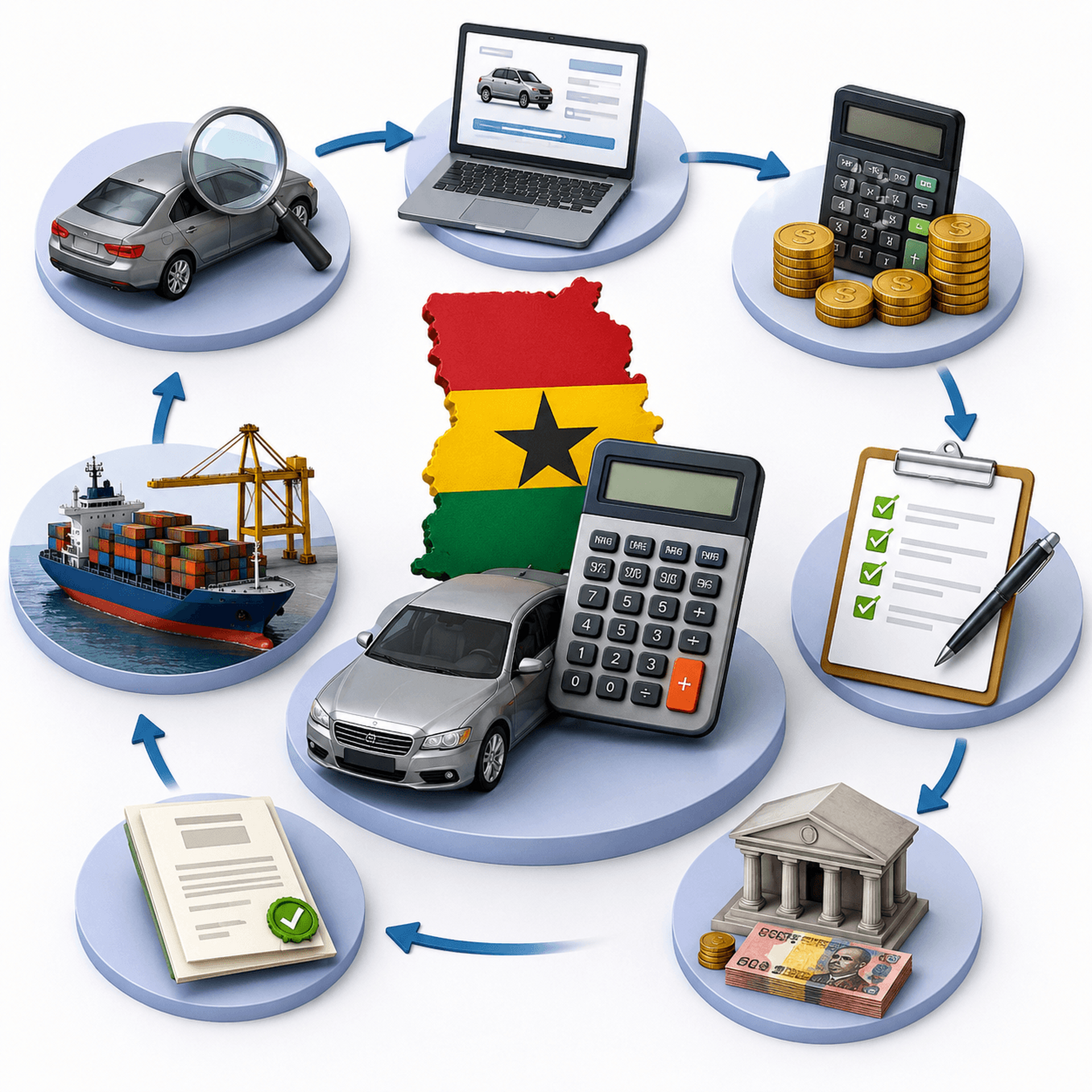
Those are not final Ghana-used prices. A fair comparison adds freight, insurance, duty, port and clearing costs, exchange-rate movement, inspection findings, tyres, registration, and immediate service work. A local used car can still be better if its Ghana history is clean and the seller's price already reflects those costs.
VEHICLE & CONTACT INFORMATION
A Ghana-used car is not automatically a bad car
Some Ghana-used cars are better buys than home-used cars because the owner maintained them properly and the price is honest. A locally used car with records, good tyres, clean suspension, working AC, and no accident story can beat a vague home-used unit.
The buyer should stop treating the label as the inspection. The label starts the question. The inspection answers it.
The label can hide the same risks
Both labels can hide accident repair, mileage rollback, weak suspension, overheating, poor AC, and tired tyres. Home-used cars can also hide source-market damage before import. Ghana-used cars can hide hard local use.
That is why the buyer needs a repeatable evidence pack. It protects the buyer from paying for a story instead of a car.
The proof behind home used vs Ghana used car before deposit
A Ghana buyer should not accept "clean car" as enough proof. Before deposit, the seller should show a small evidence pack that makes the exact unit easy to compare against another exact unit.
| Evidence item | What the buyer should ask for | Why it matters in Ghana |
|---|---|---|
| VIN and paperwork | VIN, year, trim, source market, title/import path | Confirms the exact car before price comparison |
| Service history | Receipts, inspection notes, mileage logic, fluid history | Shows whether the car was maintained or only cleaned |
| Accident evidence | Paint, panel gaps, underbody, glass, lights, airbags | Separates a clean unit from a repaired story |
| Mechanical test | Cold start, gearbox, AC, cooling, suspension, brakes | Catches the cost that photos hide |
| Ghana readiness | Tyres, registration, insurance, first-service reserve | Turns landed price into ready-to-use cost |
If the seller cannot provide these details, the buyer may still continue the conversation, but the missing proof should change the price. Missing evidence is not a small detail. It changes the risk, the resale story, and the buyer's ability to negotiate.
A home used vs Ghana used car worksheet buyers can reuse
Use this worksheet before comparing two offers. The real answer should be rebuilt on the same day using the exact VIN, current exchange-rate assumptions, inspection result, and first-service budget.
| Worksheet line | Home-used car question | Ghana-used car question |
|---|---|---|
| Ownership trail | Is the import and owner story clear? | How many local owners and what use? |
| Mileage logic | Does the mileage match age and condition? | Does wear match the odometer? |
| Service records | Any documents before and after import? | Any local maintenance receipts? |
| Inspection result | Is suspension, AC, tyres, body, and gearbox clean? | Is the lower price enough for repairs? |
| Negotiation point | What proof earns the premium? | What repair list earns the discount? |
The worksheet keeps the decision practical. It shows whether the lower price is still lower after repairs, and whether the higher price is supported by resale, condition, and service access.
The home used vs Ghana used car inspection check before payment
Inspect the car in daylight. Check paint shade, panel gaps, glass markings, tyre age, suspension noise, brake feel, AC cooling, dashboard warnings, and gearbox behaviour. Match VIN and documents before comparing price.
For imported units, add the landed-cost layer: invoice, freight, insurance, customs estimate, exchange-rate date, registration, insurance, and a first-service reserve. Ghana Revenue Authority guidance makes clear that vehicle importation depends on documentation and valuation inputs, so a buyer should not treat a foreign listing price as a Ghana-ready price.
Local buyer context for home used vs Ghana used car
The phrase home used can sound reassuring, but it should never replace inspection. A newly imported car may still have accident history, mileage concerns, auction repairs, or hidden mechanical issues. The label only tells part of the story.
Ghana used can also be a good buy when the owner has maintained the car well. Local use gives clues that an imported listing may not show: tyre wear, suspension condition, AC strength, cooling behaviour, and how the car handles Ghana roads after months of use.
The buyer's job is to compare proof, not labels. Ask for VIN, import path, service records, accident checks, and a realistic first-service budget. If a Ghana used car has stronger evidence than a home used car, the local car may be the safer purchase.
Final buying rule
Before choosing, price the first month of ownership. Add inspection, fluids, tyres, AC, suspension, registration details, and a repair reserve. This is where the home used label can lose its shine, and where a well-kept Ghana used car can become attractive. The label matters less than the real cost after handover.
For a first-time buyer, this reserve also reduces pressure during negotiation. It gives room to walk away from a weak story and choose the car with cleaner proof.
Proof wins.
Clear proof protects cash.
Key Takeaways
- home used vs Ghana used car is a proof-based decision, not a badge argument.
- what is home used car Ghana should be compared on the exact VIN, trim, mileage, condition, and service history.
- home used vs Ghana used price difference depends on buyer route, repair access, resale plan, and first-service budget.
- The cheaper option is only cheaper when the inspection report and ownership worksheet still support it.
- Before deposit, ask for documents, mechanical proof, accident checks, and a realistic Ghana-ready cost.
VEHICLE & CONTACT INFORMATION
FAQs
A
In Ghana usage, home-used usually means a car presented as cleaner, recently imported, or lightly used locally. Buyers should still verify documents, mileage, service history, and condition.
A
No. A well-maintained Ghana-used car can be better than a vague home-used car. Condition proof matters more than the label.
A
Pay more only when the evidence supports it: cleaner ownership trail, service records, low wear, clean inspection, and fewer immediate repair needs.
A
Start with VIN, documents, service records, accident history, gearbox behaviour, AC, cooling, suspension, tyres, and a road test. Price should come after proof.
A
Only if inspection supports the saving. A cheaper car with weak records, poor tyres, bad AC, or accident repairs can become more expensive than the cleaner unit.
A
Compare purchase price, first service, tyres, insurance, registration, fuel, parts access, downtime risk, and expected resale value.
A
Guazi can help buyers and dealers compare documented used-car options, inspection evidence, and sourcing choices before committing to a specific unit.
A
Do not pay based on badge, label, or listing price alone. Ask for documents, inspection proof, and a written cost picture for the exact car.




About Us
Follow US


Copyright © 2015~2026 https://ylqc.guazi.com/, Yilanqunche Automobile Services (Shanghai) Co.,Ltd. All rights reserved.