


Guazi
GlobalEnglish


Makes
Buy It NowAuctionsUp to 160 psPort StockAll VehiclesPopular Makes


Shop By Type


Popular Models


Shop By Budget

How EV Charging in Poland Really Works in 2026
Article OverviewThe EV charging network in Poland in 2026: who runs it, what a kWh costs in PLN, how to plan a long trip, and why home charging changes everything.
Note: Every PLN-per-kWh figure here is a 2026 reference point, compiled mid-2026 from Polish operator tariff pages (Orlen Charge, GreenWay, Ionity and others) and includes the 23% VAT that applies to public charging. Charging tariffs in Poland move quickly, operators re-price within a year, so treat these as a planning guide rather than a quote, and check the live price in each operator's app before you plug in.
Back in 2022, charging an electric car in Poland was a genuine worry. Fast chargers were rare, the map had real holes, and a long drive meant planning around the few sites you trusted. By 2026 that picture has changed faster than almost anywhere else in Europe. Fast chargers were barely 11% of the country's public points a few years ago, and they are on track to make up roughly half of them by the middle of this year. The honest question about the EV charging network in Poland is no longer "are there enough chargers." It is "which operator, what card, and what will it actually cost me."
This guide answers that from a buyer's seat rather than an operator's. We start with how far the network has really come, then walk through the operators you will actually meet, the difference between AC and DC charging and when each matters, what a kilowatt-hour costs in PLN, how to plan a long trip across Poland or to the German border, and why charging at home quietly rewrites the whole cost equation. We close on the NaszEauto subsidy and where a used EV fits if you want a cheaper way into all of this. By the end you should be able to judge whether you can live with an electric car here, because in 2026 the answer is usually yes.
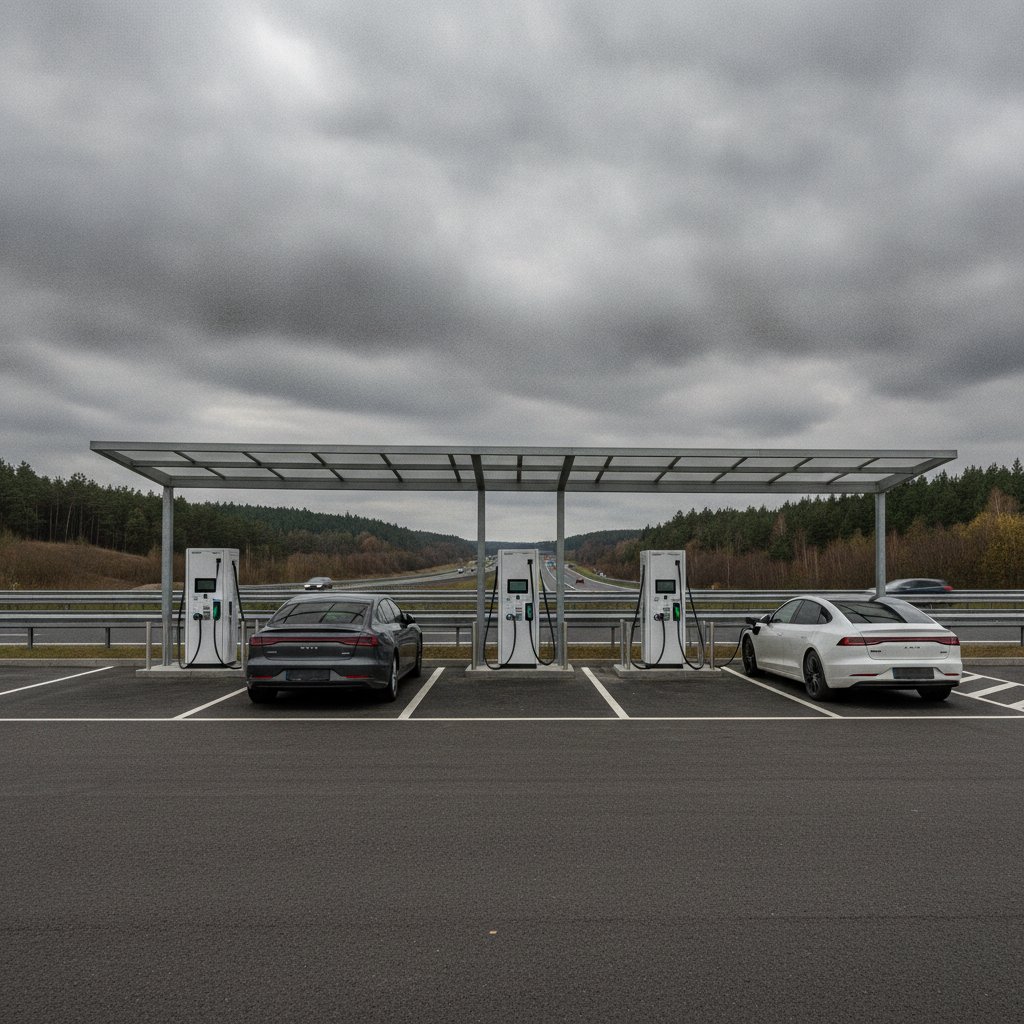
How far Poland's charging network has actually come
The speed of the build-out is the real story. Poland has become the main growth engine of Eastern Europe's charging infrastructure, with public capacity expanding at roughly 50% year on year. The shift that matters most to a driver is not the raw count of plugs but their power. A few years ago the network was dominated by slow AC posts; now fast DC chargers of 50 kW and above are closing in on half of all public points, and the new sites going in are far quicker than that. That is the difference between an EV being a city-only second car and being the only car a Polish family needs.
The numbers behind the build-out
GreenWay, the largest independent fast-charging operator in the country, is partway through a 330M PLN programme that adds around 1,500 new charging points by 2026, including 35 new hubs under its Expand-E plan that bring 139 fast stations and 253 points running at 150 to 400 kW. Polenergia has switched on 400 kW ultra-fast chargers on the A2, currently among the quickest in Poland. Ionity runs 350 kW sites on the A2 between Warsaw and Berlin and on the A4 between Wrocław and Kraków. The pattern is clear: the money is going into high-power DC on the motorways, exactly where range anxiety used to live.
Where coverage is strong, and where it is still thin
Coverage is no longer uniform good news, but it is good news in the places most people drive. The big cities, Warsaw, Kraków, Gdańsk, Wrocław, Poznań, are well served, and the main motorway corridors are now dependable. The A2 to the German border has the best coverage of any route in the country. Where you still need to think is the rural east and the smaller towns off the expressway network, where a fast charger can be 40 or 50 km apart rather than 15. For daily life and main-road travel this rarely bites; for a back-roads holiday in the east it pays to map your stops in advance rather than assume.
The operators you will actually meet
Poland's charging market is a handful of networks rather than one national grid, and knowing who covers what saves you real money and hassle. You do not need an account with all of them, but you do need to understand the landscape before you pick.
Orlen Charge is the one you will see most often, run by the state fuel giant and tied to the petrol stations Poles already know, which makes it the default for many first-time EV drivers. GreenWay is the largest independent fast-charging network and the one road-trippers lean on, with the densest motorway coverage and a subscription model that rewards regular users. Ionity, the pan-European venture backed by major carmakers, runs the high-power 350 kW corridors and is built for fast cross-border hops rather than cheap top-ups. Around these three sit a useful supporting cast: Polenergia with its ultra-fast A2 sites, EkoEN which often posts some of the cheapest off-peak rates in the country, and Tesla, whose Supercharger network is now partly open to non-Tesla cars and is among the cheapest DC charging you can find anywhere in Poland.
The practical takeaway is simple. Pick one main network that matches your driving, usually Orlen Charge if you mostly charge around town and GreenWay if you cover long distances, then keep a second app as backup for the gaps. Here is how the main operators compare on what a buyer actually cares about.
| Operator | AC PLN/kWh | DC PLN/kWh | Monthly fee | Best for |
|---|---|---|---|---|
| GreenWay "Maximum Energy" | 1.60 | 2.10 | 79.99 PLN | High-mileage and long-distance drivers |
| GreenWay "More Energy" | 1.75 | 2.40 | 29.99 PLN | Regular but moderate users |
| Orlen Charge | 1.95 | 2.69 to 3.19 | none | Everyday town charging, familiar stations |
| Ionity Direct | n/a | 3.50 | none | Occasional fast motorway top-ups |
| Ionity Passport Motion | n/a | 2.50 | 28.50 PLN | Frequent cross-border travel |
| Tesla Supercharger | n/a | from 1.50 | optional | Cheapest DC, where sites are open to all |
AC or DC: which one you need, and when
Almost every charging decision in Poland comes down to one distinction, and getting it straight removes most of the confusion. AC charging uses the Type 2 connector every modern EV in Europe carries, runs at modest power, and is what you use overnight at home, at work, or parked in town for a few hours. It is slow by design, often adding 20 to 40 km of range per hour, but that barely matters when the car is sitting still anyway. DC fast charging uses the CCS2 connector, delivers far more power, and is what you use on a journey when you need a meaningful top-up in the time it takes to drink a coffee.
The rule of thumb is easy to apply. If the car is parked where you already are, home, office, hotel, a shopping centre, use AC and let it trickle. If you are on the move and the battery is getting low, find a DC site, plug in, and aim for a 10 to 80% top-up rather than a full charge, because that last 20% charges slowly on every EV and wastes your time. Most Polish drivers end up doing the overwhelming majority of their charging on cheap AC at home and only touch DC on longer trips, which is exactly the pattern that makes an EV affordable here.
What does it really cost to charge in Poland?
This is the question behind most searches, and the honest answer depends entirely on where you plug in. The median price of public DC charging in Poland sits around 2.48 PLN/kWh including VAT, with a wide spread: the cheapest off-peak rates from operators like EkoEN dip to about 1.49 PLN/kWh, while premium high-power sites can reach 3.39 PLN/kWh. Tesla Superchargers, at roughly 1.50 PLN/kWh and dropping toward 1.00 PLN with membership, sit among the cheapest fast options. Home energy is in a different league entirely, which is the point most cost comparisons miss.
Whether a subscription pays off is just arithmetic. GreenWay's 79.99 PLN/mo "Maximum Energy" plan drops DC to 2.10 PLN/kWh against the pay-as-you-go reality of 2.40 to 3.00 plus, so if you fast-charge more than a few hundred kilowatt-hours a month it clears its cost easily; charge rarely and the no-fee Orlen Charge or Tesla open sites make more sense. Match the plan to your real mileage rather than the headline rate.
A worked example: charging a mid-size EV from 10 to 80%
Picture a typical mid-size Polish EV with a usable battery around 60 kWh. Going from 10 to 80% adds roughly 42 kWh. On a mid-priced public DC charger at about 2.70 PLN/kWh, that top-up costs around 113 PLN and adds something close to 250 to 300 km of real range, taking perhaps 25 to 35 minutes on a 100 kW-plus site. The same 42 kWh charged at home on a domestic tariff, very roughly 1.00 to 1.20 PLN/kWh depending on your contract, costs around 42 to 50 PLN. Same electricity, less than half the price. That gap is the single most important number in EV ownership in Poland, and it is why the next two sections matter so much.
Planning a long trip: Warsaw to Kraków, and Poland to the German border
Long-distance driving is where new EV owners feel the most nerves and where the 2026 network has improved the most. On the main corridors, the A1, A2 and A4 plus the S8, fast chargers now sit roughly every 80 to 120 km, so the job is less about finding a single charger and more about choosing which hub to stop at. Plan around hubs with several stalls rather than lone posts, so a busy site or a broken unit does not strand you, and you will rarely wait.
A Warsaw to Kraków run of around 300 km is comfortably a single-stop journey for most modern EVs, or even non-stop for longer-range cars in mild weather. A drive west to the German border is the easiest of all, since the A2 has the country's densest fast-charging coverage and Ionity's 350 kW sites make short work of a top-up. The practical routine looks like this:
- Charge to 100% at home the night before so you start full and skip the first stop.
- Drive your first leg down to roughly 15 to 20% rather than chasing empty.
- Stop at a multi-stall DC hub, plug in, and charge to about 80% while you take a break.
- Repeat only if the route demands it; most domestic trips need one stop, not three.
- In winter, add a margin: cold weather can trim real range by 20 to 30%, so stop a little earlier.
Charging at home: the cheapest kilometre you will drive
If you can charge at home, it changes everything about owning an EV in Poland, and it is worth treating as the foundation of the decision rather than an afterthought. Home charging means you wake up with a full battery most mornings, you almost never queue, and crucially you pay domestic electricity rates that are a fraction of public DC prices. For anyone with a driveway, garage or allocated parking with power nearby, this is the quiet reason an EV can be cheaper to run than a petrol car here.
Wallbox cost and installation in Poland
A home setup is a one-off cost with a long payback. The wallbox itself runs from roughly 600 to 1,500 €, and a typical installation by a qualified electrician adds another 400 to 900 €, so a realistic all-in budget lands around 1,000 to 2,400 € plus VAT, or roughly 4,000 to 9,600 PLN depending on your home's wiring and the unit you choose. It is not trivial, but spread across years of driving on cheap overnight power it pays for itself, especially if your energy contract offers lower night-time rates.
Why home charging changes the cost equation entirely
Once home charging is in the picture, the public network stops being your main expense and becomes a convenience for journeys. A driver who charges 80 to 90% of the time at home and only uses DC on trips spends dramatically less per kilometre than the public-only figures suggest. This is the honest reason the "is it expensive to charge in Poland" question has no single answer: for a home charger it is genuinely cheap, and for someone relying entirely on public DC it is merely reasonable. Where you park at night decides which of those you are.
Subsidies and the cost of going electric in Poland in 2026
Buying the car, not charging it, is the bigger expense, and Poland's NaszEauto programme is designed to soften it. The scheme can take up to around 40,000 PLN off the price of a qualifying new battery-electric car, which meaningfully changes the maths on popular models from BYD, MG, Tesla and others. Eligibility depends on the vehicle's net price and the buyer's circumstances, so the exact figure varies. One important caveat: the programme runs to a set deadline or until its funds are exhausted, whichever comes first, and by the time you read this the window may be closing or changed. Treat it as a reason to check current availability rather than an evergreen discount, and confirm the live terms before you count on it.
If you want the cheapest route into the network covered in this guide, the cars Polish buyers increasingly cross-shop are worth a look across our companion pieces on the Xiaomi SU7 in Poland, Tesla's Polish line-up, BYD's range in Poland and MG's value EVs.
A few things worth knowing before your first public charge
A handful of small habits separate a smooth first public charge from a frustrating one, and none of them are obvious until someone tells you. Keep these in mind:
- Download the apps for your main two operators before you need them; setting up payment at a cold, dark charger is no fun.
- An RFID charging card is a useful backup for when an app refuses to connect or there is no signal.
- Aim for 10 to 80% on DC and move on; the final 20% is slow everywhere and you are blocking a stall.
- Do not leave the car plugged in long after it finishes on a busy site; some networks add idle fees, and it is poor etiquette.
- In winter, precondition the battery while still plugged in at home if your car allows it, so it charges faster on the road.
- Check the stall's power before committing; a 50 kW post and a 150 kW post add range at very different speeds.
Where a used EV fits, and how Guazi helps
Charging confidence is half the EV decision; the price of the car is the other half, and a used electric car is often the cheapest way in. Many of the EVs Polish buyers are now considering, BYD, MG and used Teslas among them, are Chinese-made new-energy vehicles, which is precisely the category Guazi knows best. As one of China's largest used new-energy-vehicle platforms, Guazi is built around standardized inspection of exactly these cars, so the same battery-health and condition checks that matter when buying any used EV are what the platform does at scale. We are not a charging operator and we do not retail cars into Poland; what we offer is a buyer's-side view of the used-EV market that sits naturally alongside a charging guide like this one. If a lower entry price is what stands between you and an EV, starting from an inspected used car rather than a new one is worth a serious look. Browse inspected used EVs at Guazi
Thinking about going electric in Poland? The network is ready; the next question is the car. See inspected EVs in stock
Key Takeaways
- The EV charging network in Poland has roughly quadrupled its fast-charger share since 2022 and now supports normal long-distance driving on the main corridors.
- The question is no longer whether chargers exist but which operator and card suit you; pick one main network, usually Orlen Charge in town or GreenWay for distance, plus a backup app.
- Public DC charging runs around 2.48 PLN/kWh on average, but home charging at roughly 1.00 to 1.20 PLN/kWh is less than half the price and should be your default if you can install a wallbox.
- Long trips work: fast chargers sit every 80 to 120 km on the A1, A2 and A4, so plan around multi-stall hubs and a single 10 to 80% stop.
- The NaszEauto subsidy can cut up to around 40,000 PLN off a qualifying new EV, but it runs until funds are exhausted, so confirm current availability before counting on it.
Sources & References
- GreenWay Polska, media and price-list updates
- electrive, GreenWay Eastern Europe fast-charging expansion
- eleport, Poland fast-charging price report 2026
- Orlen Charge pricing
- Polenergia, fastest chargers on the A2
Wondering whether an EV makes sense for your driving in Poland?
Our team can walk you through inspected used EVs and the battery-health report that matters most before you commit.





About Us
Get Support
Follow Us


Copyright © 2015~2026 https://en.guazi.com/, Chongqing Guazi Enterprise Consulting Service Co., Ltd. All rights reserved.